

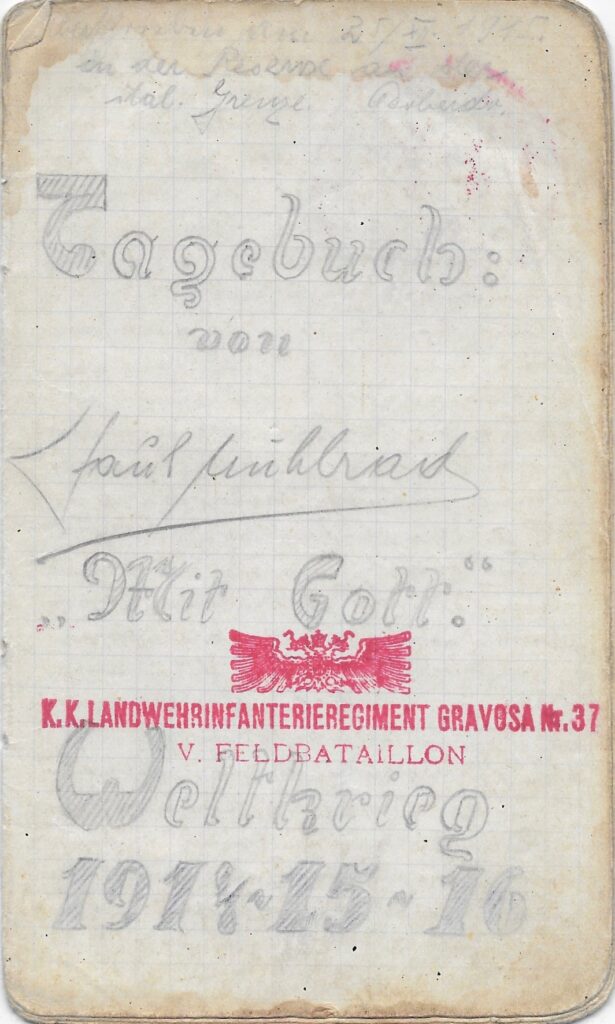
My grandfather, Paul Joseph Mühlrad, was 17 years old when Kaiser Franz Joseph declared war on Serbia on July 28, 1914, exactly one month following the assassination of Franz Joseph’s nephew, and heir presumptive, Archduke Franz Ferdinand in Sarajevo. Like all young men in the Austrian-Hungarian Empire, Paul entered the military in service to his beloved homeland and Kaiser. From December 15, 1915 and February 23, 1917, he kept a journal (“Tagebuch”), which we recently discovered. It was painstakingly translated by my friend (and 4th cousin once removed), Martin Aigner, who is not only a native Austrian German speaker, but also an American-educated English speaker and World War I historian.
Page Number
Translation
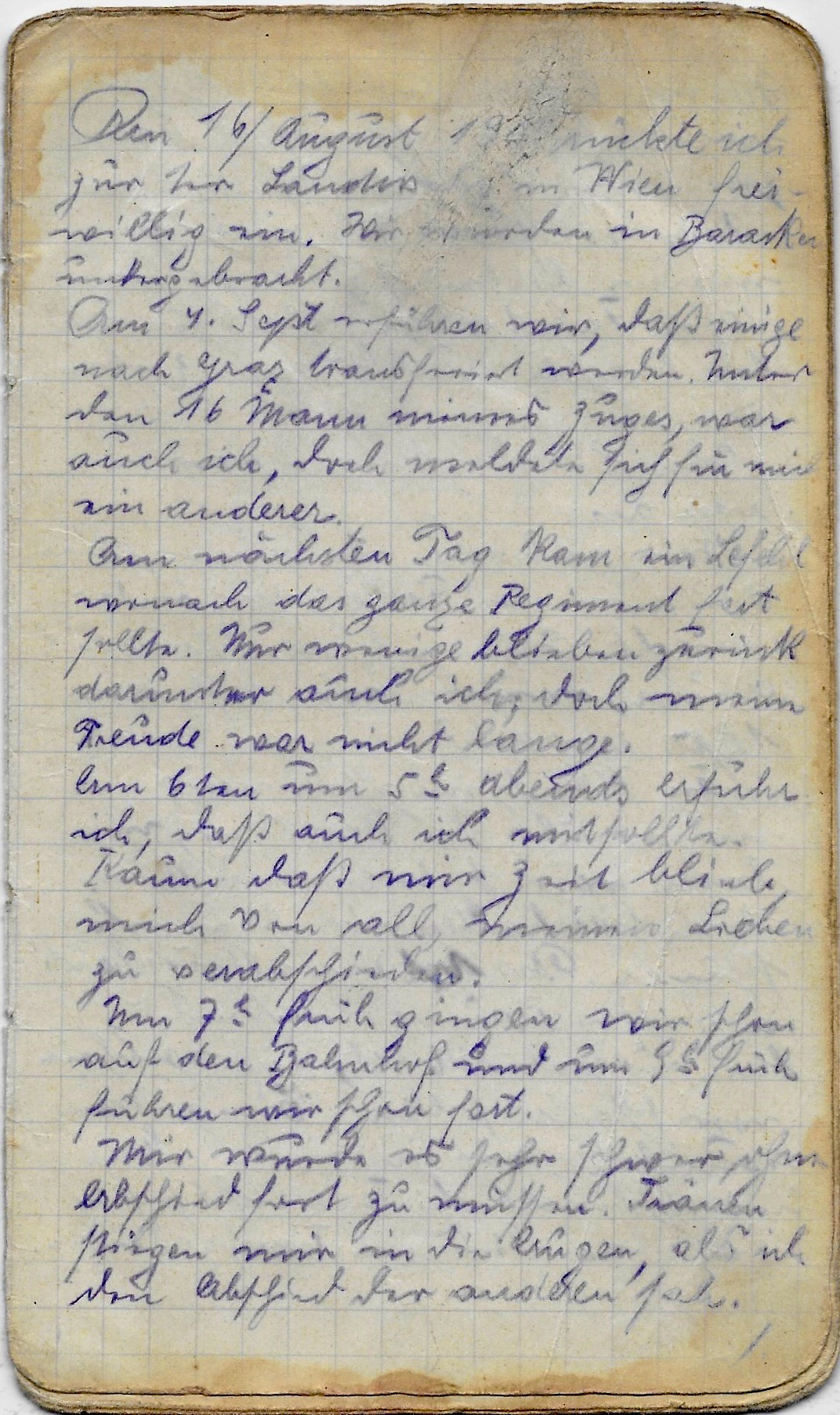
| August 16, 1915 I volunteered to for the [Landsturm?] Vienna. We were housed in barracks. On Sept. 4, we learned that some were being transferred to Graz. Among the 16 men in my platoon was me too, but someone else volunteered for me. The next day an order came according to which the entire regiment was to leave . Only a few stayed behind including me, but my joy did not last long. On the 6th at 5 o’clock in the evening I learned that I too was to go. I barely had time to say goodbye to all my loved ones. At 7am we went to the train station and at 9am we left. It was so difficuly for me … to have to leave. Tears welled up in my eyes when I saw the others saying goodbye. |
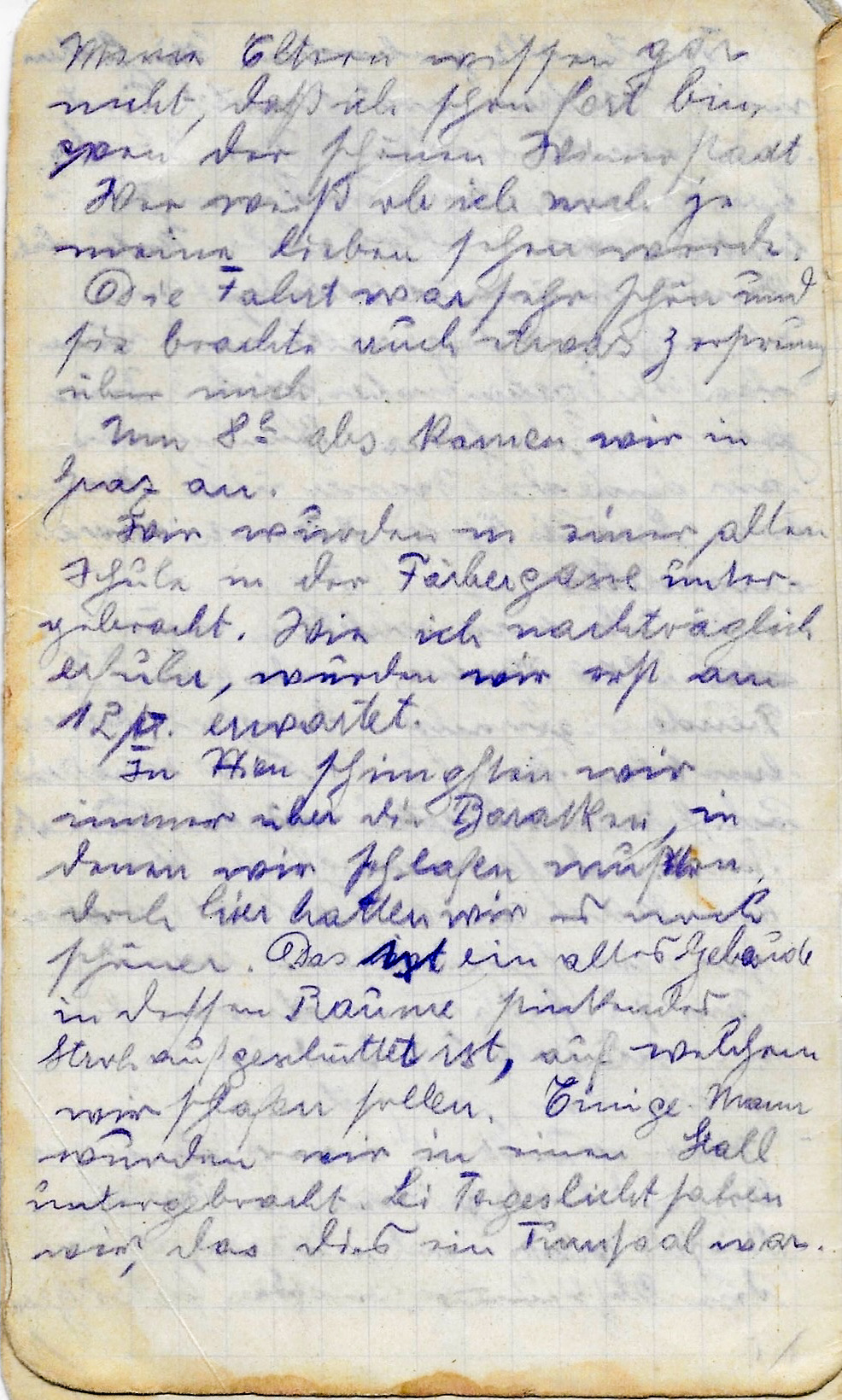
| My parents don’t even know that I’m already away from the beautiful city of Vienna. Who knows if I will ever see my loved ones again. The journey was very nice and it also brought me some distraction. We arrived in Graz at 8 o’clock in the evening. We were accommodated in an old school on Färbergasse. As I later learned, we were not expected until September 12th. In Vienna we always grumbled about the barracks we had to sleep in, but here we had it even nicer. It is an old building with straw piled up in the rooms, on which we were supposed to sleep. A few men were housed in a stable. In daylight we saw that this was a gymnasium. |
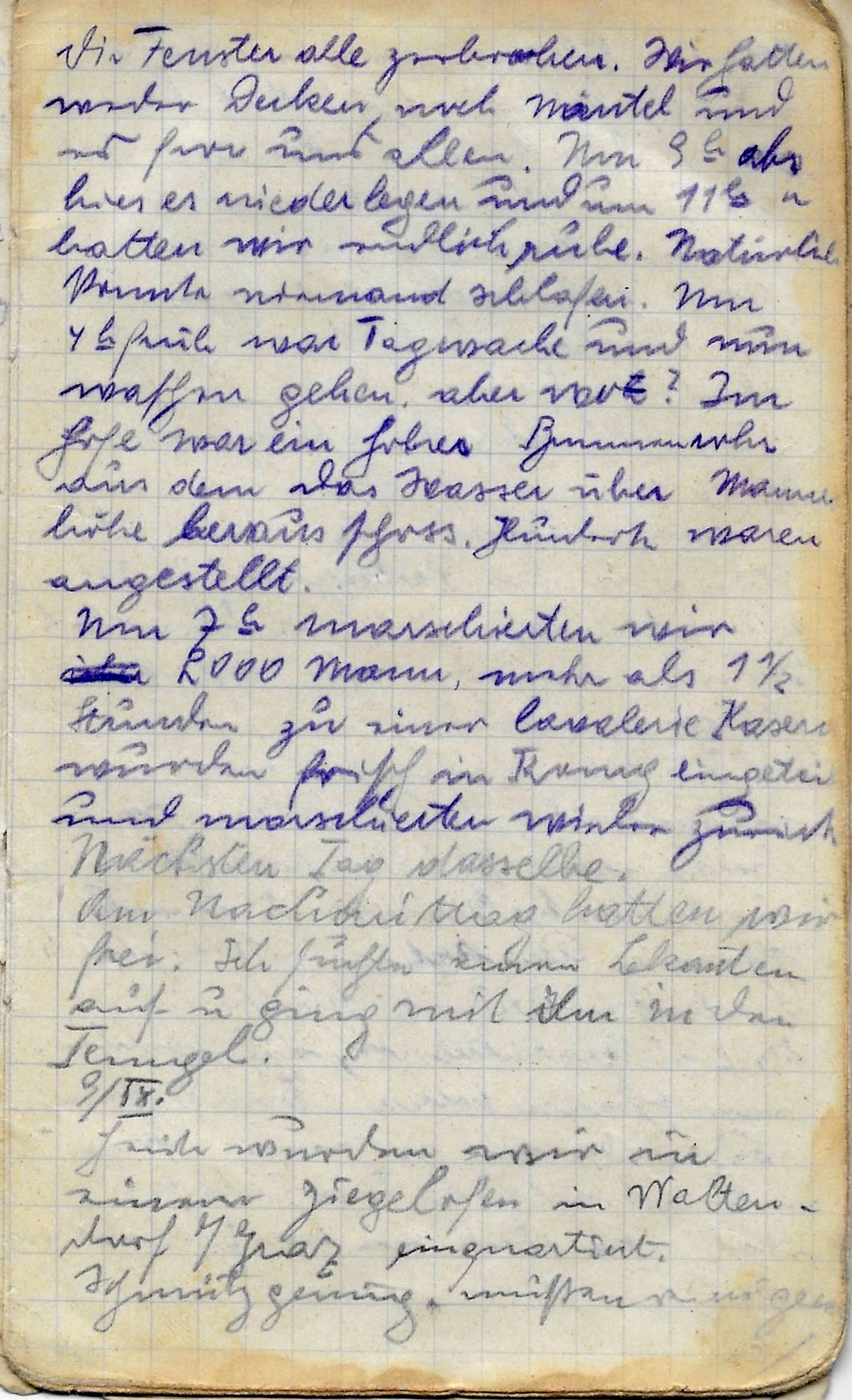
| The windows were all broken, we had neither blankets nor coats, and so we were all freezing. At 9 o’clock in the evening we were told to lie down and at 11 a.m. we finally got some rest. Of course nobody could sleep. At 4am it was time to wake up and wash. But where? In the hall there was a tall fountain-pipe from which the water flowed out at man’s height. Hundreds were lining up. At 7am we marched 2000 men, more than 1 ½ hours to a cavalry barracks were [freshly?] divided into companies and marched back again. The next day the same. In the afternoon we had time off. I visited an aquainatance and went with him to the [Teingel?]. 9.IX Early in the morning we were billited in a brick factory in Waltersdorf near Graz. Plenty of dirt, we have to clean up. |
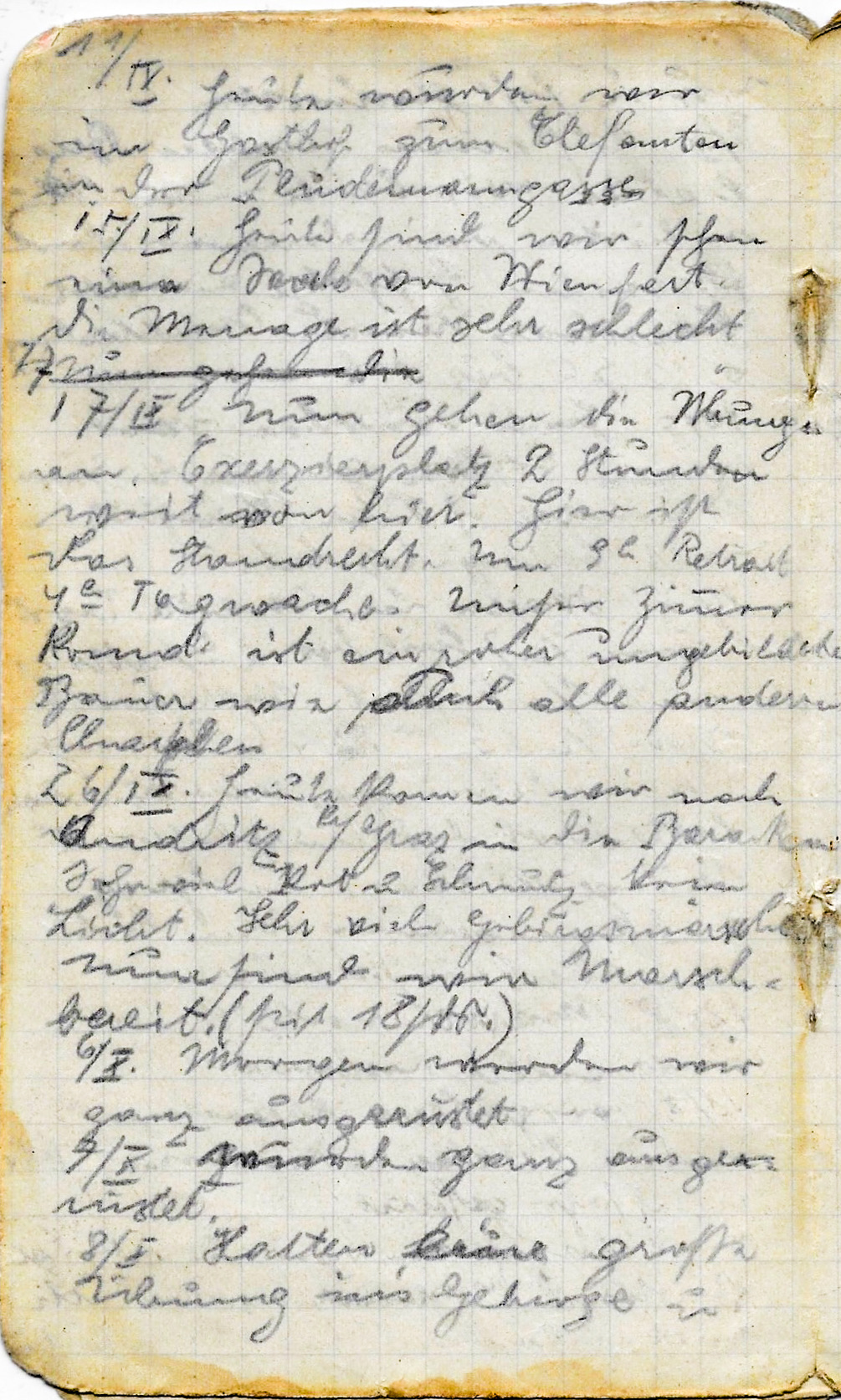
| 11/IX. We arrive early atat the Gasthof zum Elefanten in Plüdemanngasse. 15/IX. Now we already away from Vienna for a week. The food is very bad. 17/IX. Now the exercises start. The parade ground is 2 hours from here. There is military law. Bedtime at 9 am. Day watch at 4 am. Our roommateis a crude uneducated farmer [we go through all the other?] 26./IX. today we come to the barracks in Andritz near Graz. Lots of excrement and dirt. No light. A lot of mountain marches Now we are ready to march [since 18?] 6./X. Tomorrow we will be fully equipped. 7./X. Have been fully equipped. 8./X. Had a big exercise into the mountains and |
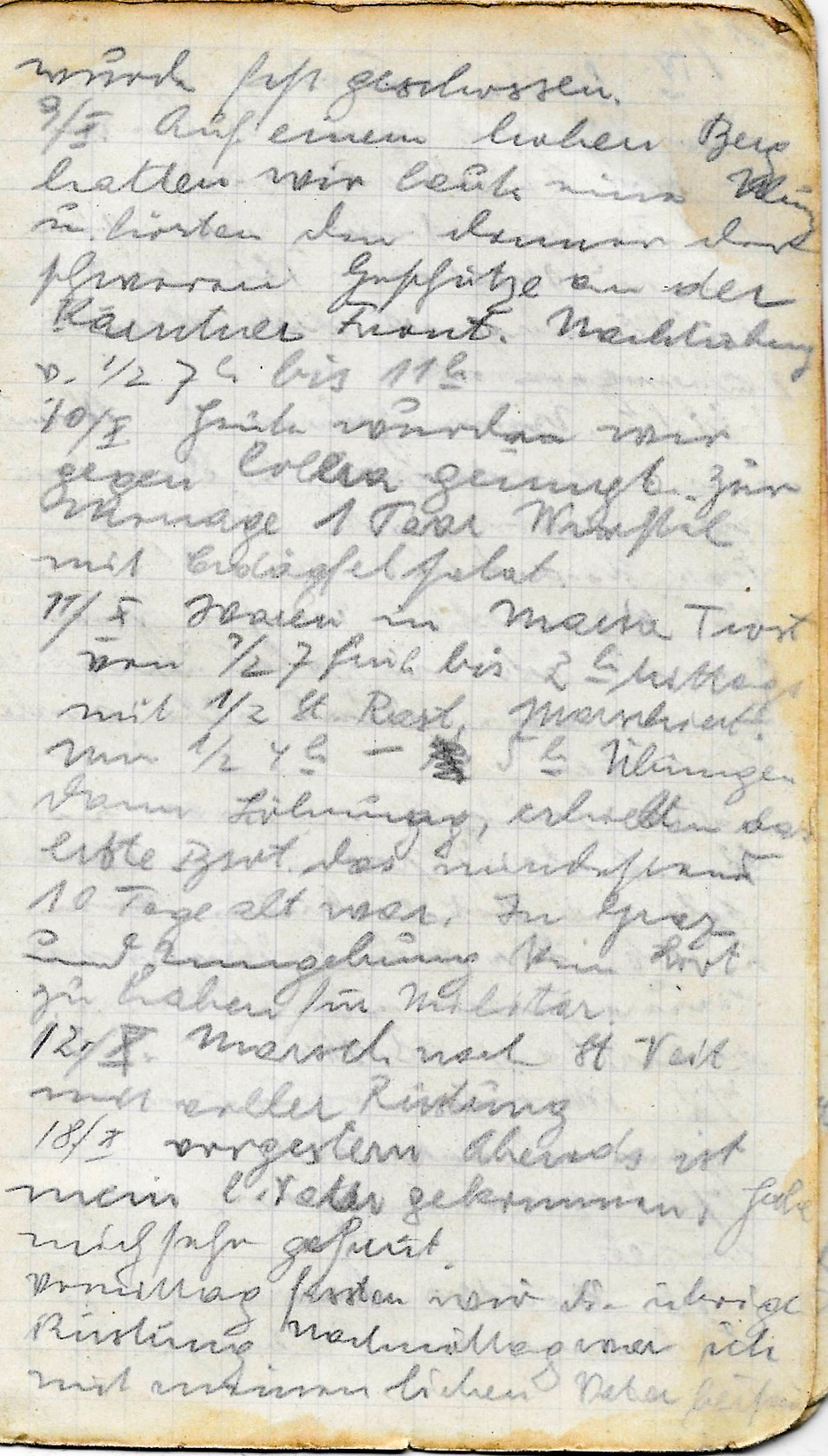
| lots of shooting. 9./X.: on a high mountain we had an exercise today and heard the thunder of the heavy guns on the Carinthian front. Night exercise from ½ 7h to 11 h. 10./X. Today we were vaccinated against cholera, for the menu 1 pair of sausages with potato salad. 11./X: Walked to Maria Trost from ½ 7 am to 2 am with a rest of ½ hour. From ½ 4h to 5h exercises then wages, received the first bread that was not already 10 days old. No bread available for the military in Graz and the surrounding area. 12./X. March to St. Veit (an der Glan) with full armor. 18./X. The day before yesterday evening my dear father arrived. I was very pleased. In the morning we collected the rest of the equipment. In the afternoon I was together with my dear father. |
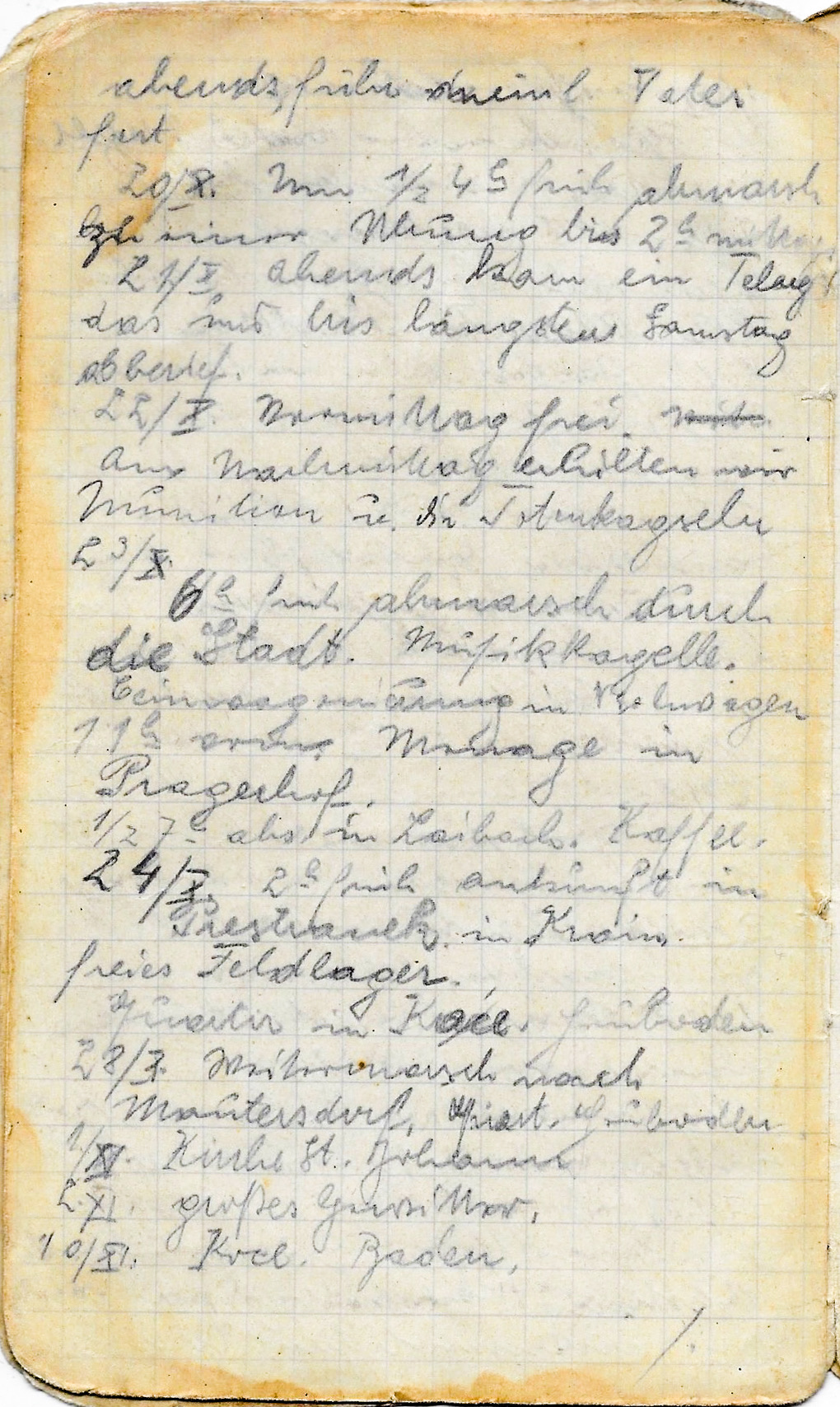
| In the evening my dear father left. 20/X. at 3:30 a.m. departure for an exercise until 2 p.m. 21/X. Morning free. In the afternoon we received ammunition and the death capsules. [dog tags] 23/X. 6 a.m. Marching through the town, marching band. Wagoning in cattle wagons. 11.00 a.m. meal in Pragerhof. 6:30 p.m. in Ljubljana, coffee. 24/X. 2 h early arrival in Prestanek in Carniola. Free encampment. Quarters in Koce. Hayloft. 28./X. Onward march to Mautersdorf. Quarters hayloft. 1ST/XI. Church of St. Johann 2nd/XI. big thunderstorm 4TH/XI. Krel, [bathing?] |
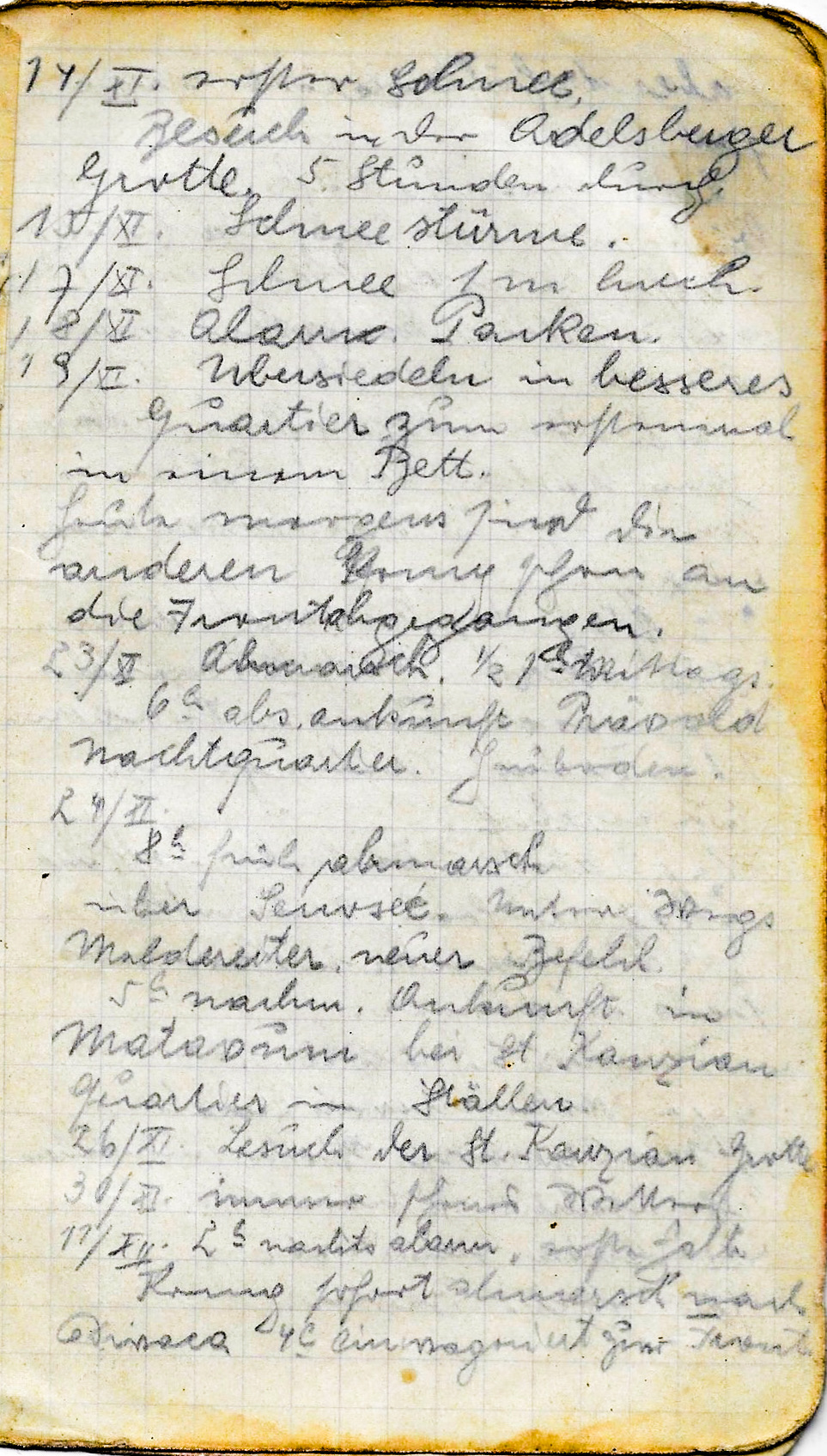
| 14./XI. first snow Visit to the Adelsberg cave. For 5 hours. 15/XI. Snowstorms 17/XI. Snow 1 meter high 18./XI. Alarm. Packing. 19./XI. Moved to better quarters for the first time in a bed. Early in the morning the other companies have already left for the front. 23./XI. Departure 11:30 a.m. 6h evening arrival Präwald. Night quarters. Hayloft 2 4th/XI. 8am Departure via Servsec. On the way a signal rider brings new orders. 5h in the afternoon arrival at Matavun near St. Kanzian. Quarters in stables 26./XI. Visit to the St. Kanzian Grotto 30./XI. always [already?] 11/XII. 2h alarm at night. Very cold. Company immediately marched to Divaca. 4h to the front. |
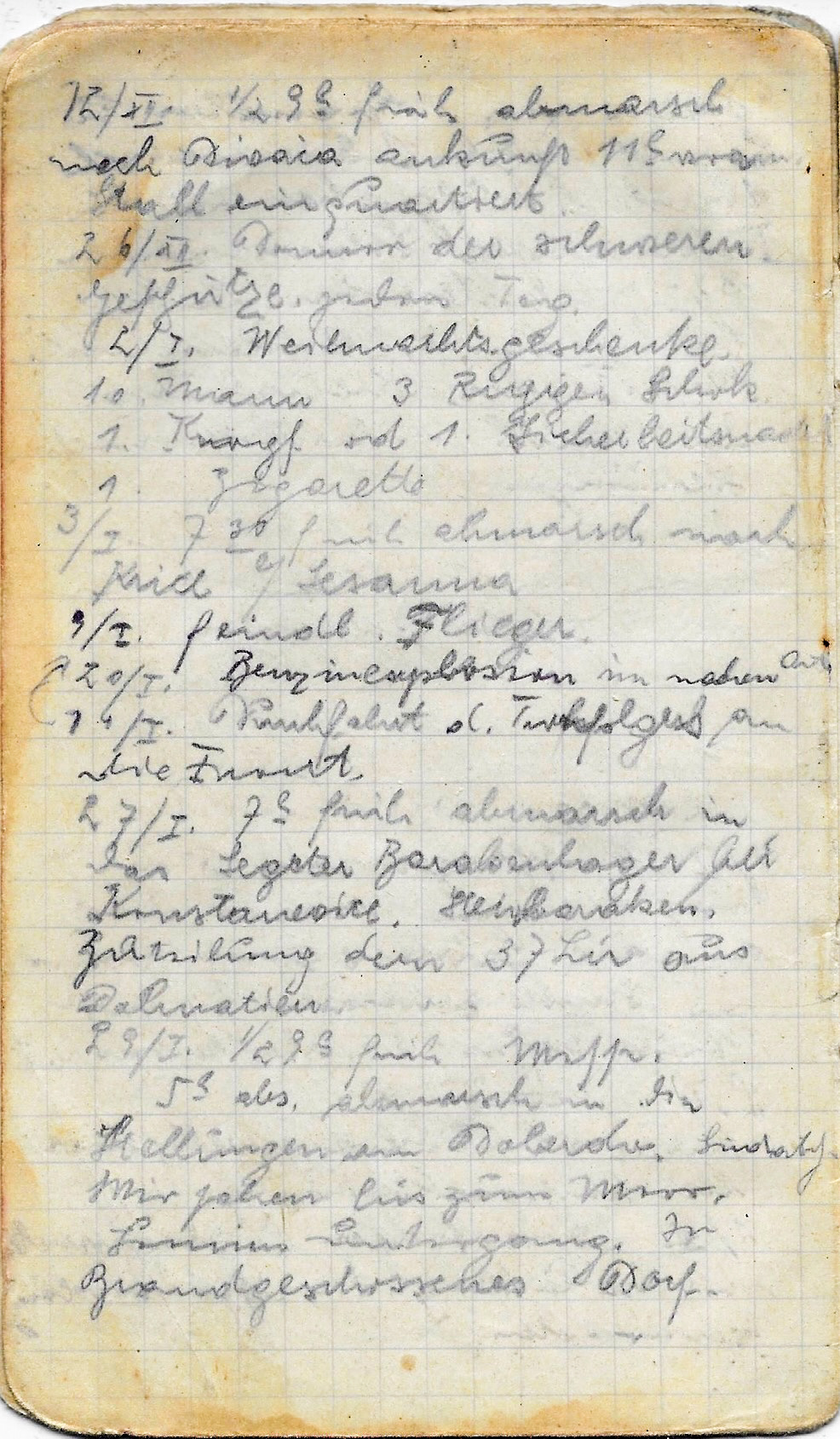
| 12./XII. 8:30 am departure for Divaca, arrival 11 am. Quartered in stable. 26./XII. Thunder of heavy guns every day. 2.I. (1916). Christmas presents 10 men 3 ribs of chocolate. 1 button or 1 safety pin 1 cigarette 3./I. 7.30 a.m. march to Krice near Sezana. 9./I. Enemy aircraft 14.I. Return to the front oft the [?] 20.I. Gasoline explosion in nearby village. 27./I. 7am march to the Barracks near Konstanjevica, stone barracks. Assigned to 37 LIR from Dalmatia 29/I. 8:30 a.m. Mass. 5h evening march to the positions at Dolberdo? South slope. We drive to [?], Sunset. burnt Village . |
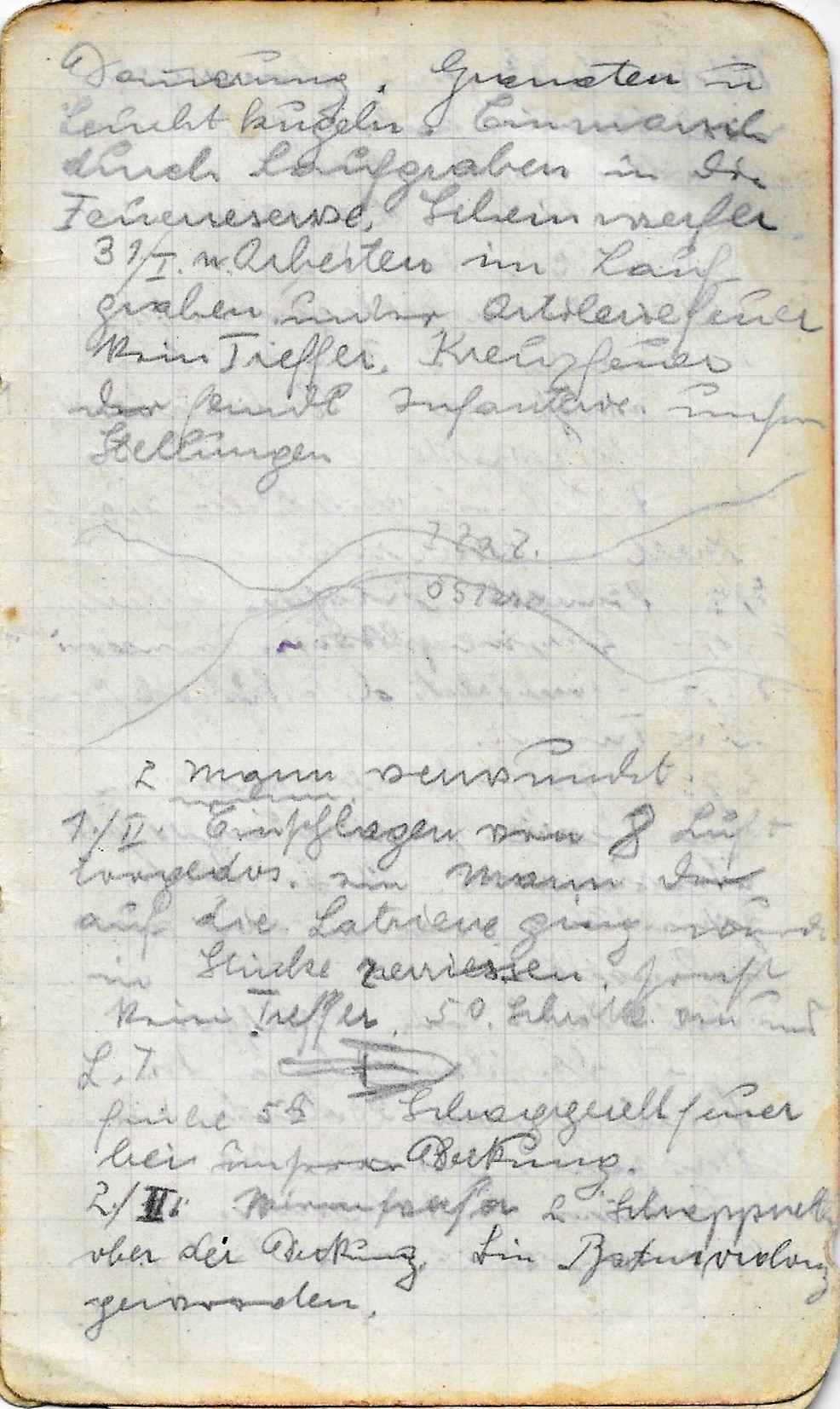
| Twilight. Grenades and flares, march through trenches into the fire reserve. Searchlights. 31./I. We work in the trenches under artillery fire. no hits. Crossfire of the enemy infantry on our positions. (position sketch) 2 men wounded. 1./II. Hit by 8 air torpedoes. A man who went to the latrine was torn to pieces. Otherwise no hits. 50 paces from us L-I- → Early 5h shrapnel fire at our cover. 2./II. Mine fire and shrapnel above the cover. Became Batallion ordnance |
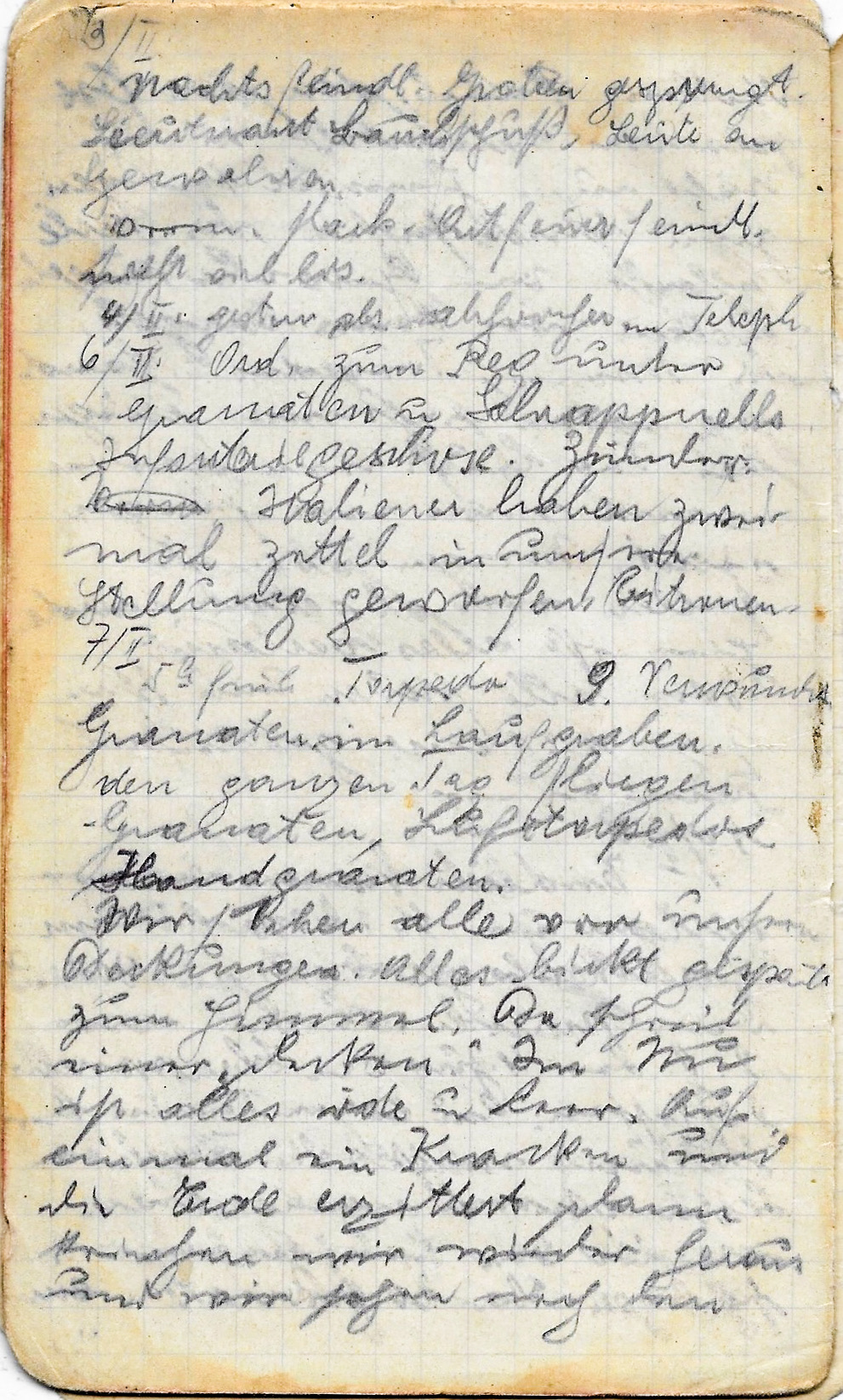
| 3./II. (1916) enemy trench blown up at night. [lieutenant?] People at rifles 10 a.m. Flak artillery fire enemy [Air?reconnaissance?] 4./II. yesterday evening I [start?] at the telephone. 6./II. Ord. to reg.(ordered tot he regiment) under Grenades, Schrapnels and Infantry shells. [??] Italians have twice thrown leaflets into our position. [??] 7.II. 5 a.m. Torpedo 9 wounded shells in the trench. All day shells, air torpedoes, hand grenades fly. We see it all from our cover. Everyone looks tensely to the sky. Someone shouts “Cover”. Inside me everything is desolate and empty. Once a crash and the earth trembles then we jump (crawl?) out again and we can still see the |
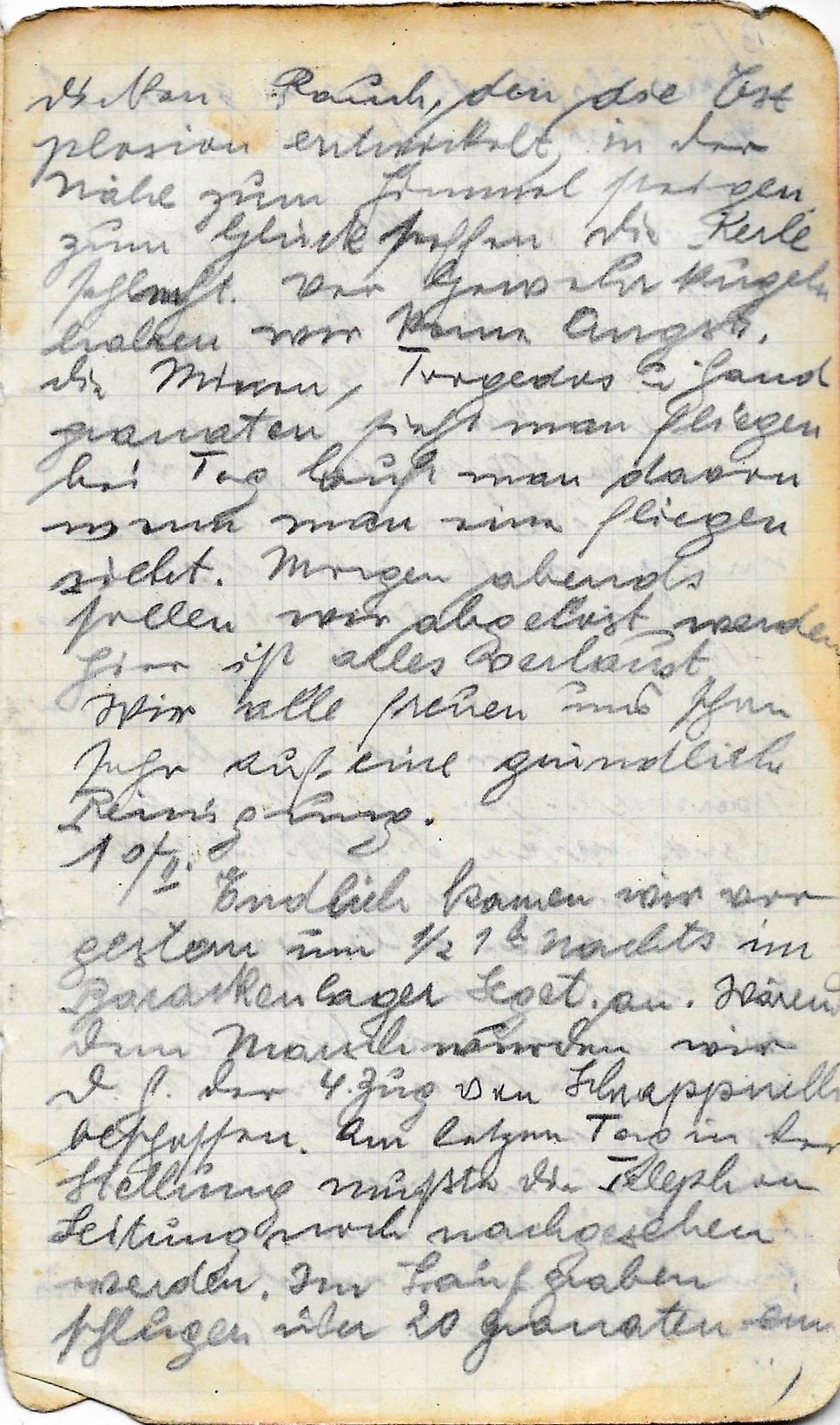
| thick smoke that the explosion develops, rising into the sky nearby. Fortunately, the guys aim badly. We’re hardly afraid of bullets. You can see the mines, torpedoes and land grenades flying. during the day you run away when you see them flying. Tomorrow evening we’re supposed to be relieved. We’re all full of lice. We’re all looking forward to a thorough cleaning. 10./II. The day before yesterday we finally arrived at the [Seget?] barracks camp at ½ 1. at night. During the march we (i.e., the 4th platoon) were shot at with shrapnel. On the last day in the position the telephone line had to be checked. More than 20 shells hit the trench |
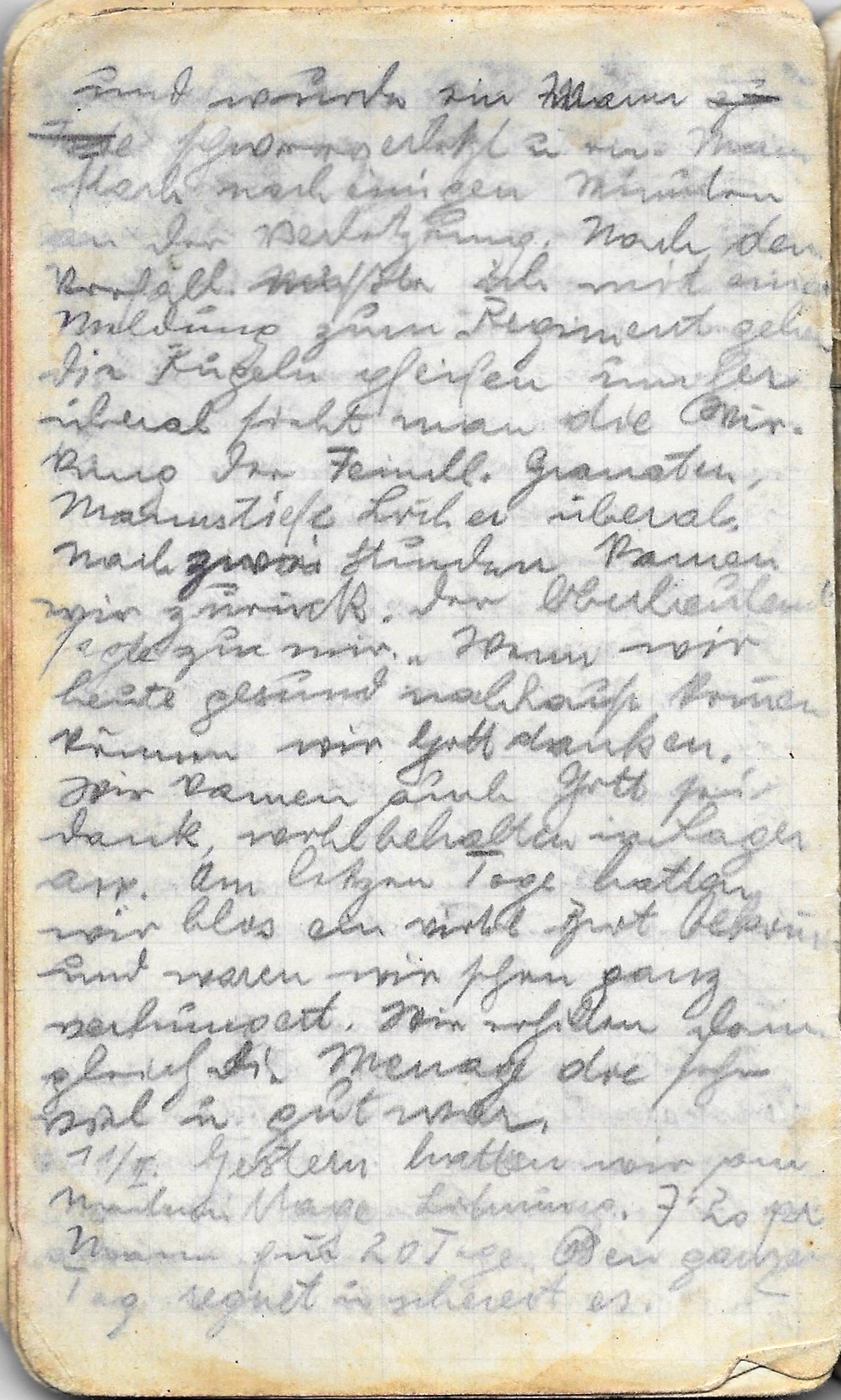
| one man was seriously wounded and one man died after a few minutes of his injuries. After the incidents I had to go to the regiment with a report. The bullets are whistling around, you can see the effect of the enemy shells everywhere. Man-deep holes everywhere. After two hours we returned. The first lieutenant said to me. “If we get home safely today, we can thank God.” Thank God we arrived safely at the camp. The last day we got only a quarter of a loaf of bread and we were already starving. We then received the menage (food) straight away, which was very plentiful and good. 11./II. Yesterday we had wages in the afternoon. 7.20 [Kronen, ca. Euro 15] per man for 20 days. It rained and snowed the whole day. |
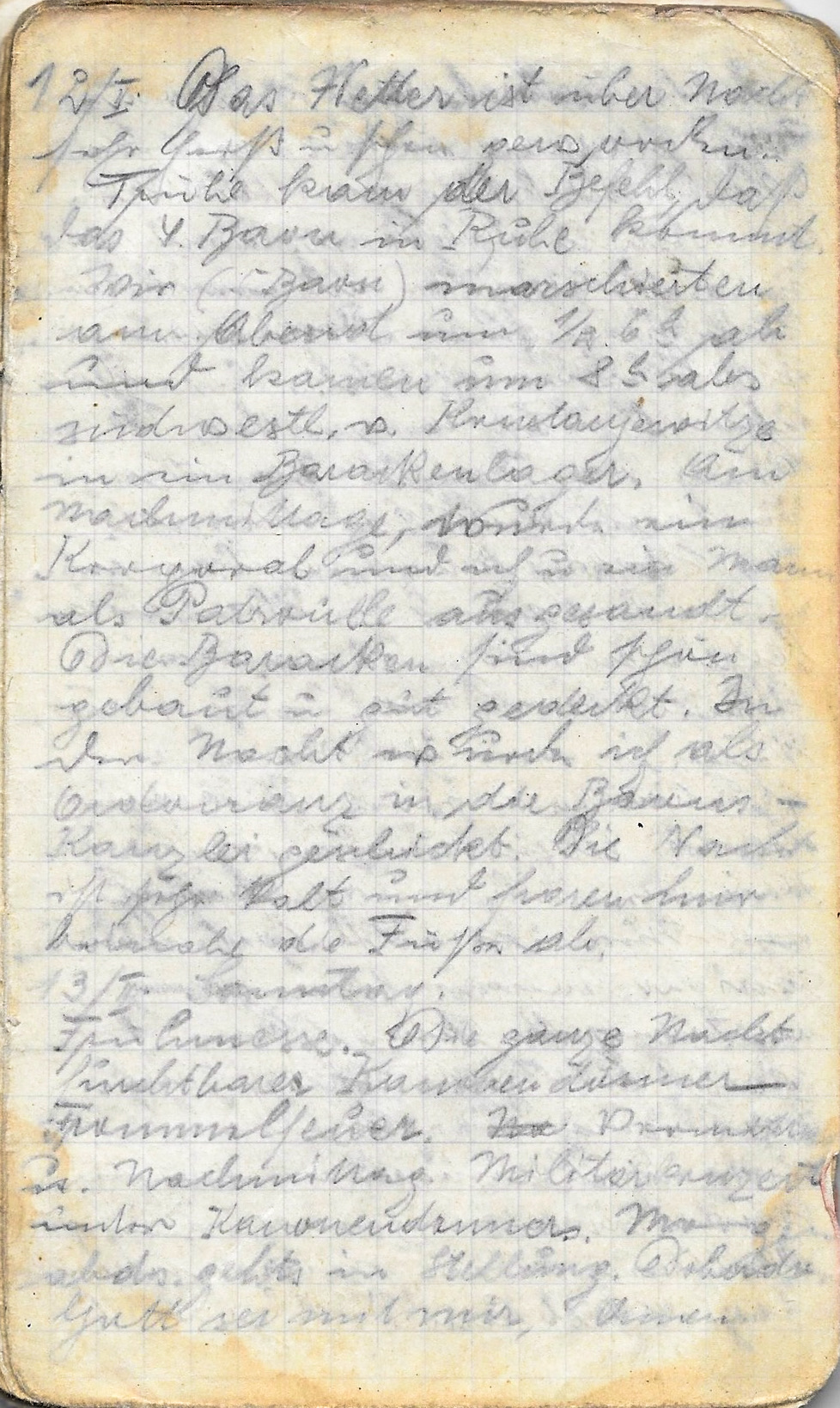
| 12./II. The weather has become very [??] and [??] overnight. Early in the morning the order came that the 4th Baon comes to rest. We (5th Baon) marched in the evening at ½ 6h and arrived at 8h pm southwest of Kostanjevica in a barrack camp. In the afternoon a corporal and I and a man were sent on a patrol. The barracks are nicely built and well covered. In the night I was sent as orderly to the Baon. HQ. The night is very cold and I almost froze my fingers [feet?] off. 13.II. Sunday. Early mass. The whole night terrible cannon thunder, drumfire, [??] Afternoon. Military concert? Under cannon thunder. Tomorrow evening we go to the position. [??]. God be with me. One (your) |
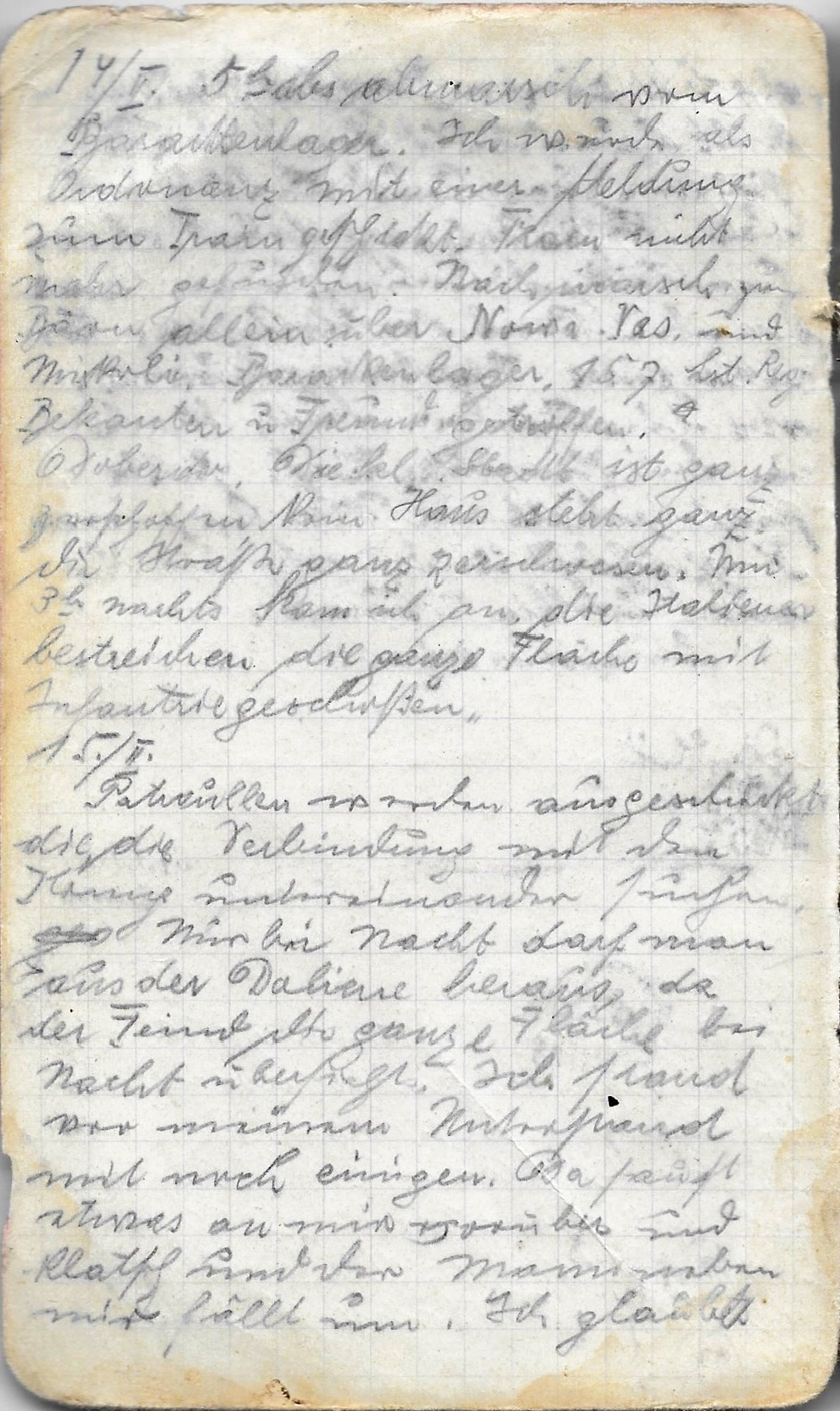
| 14./II. 5h pm departure from the barrack camp. I am sent to the train as an orderly with a message. Train not found anymore. Therafter march to the Baon alone via Nova Vas and [Misterluv?]. Barrack camp of 157th Lst. Reg. Met acquaintance and friend. Doberdo. The small town is completely hit, no house is left standing, the street is completely shot up. I arrived at 3 o’clock at night, the Italians are covering the whole area with infantry bullets. 15./II. Patrols were sent out to establish contact between the companies. Only at night may one leave the Doliene, as the enemy [Doline is a natural vertical cave, it seems they were used as shelters] overlooks the whole area at night. I was standing in front of my dugout with a few others. Then something whizzes past me and claps and the man next to me falls over. I believe |
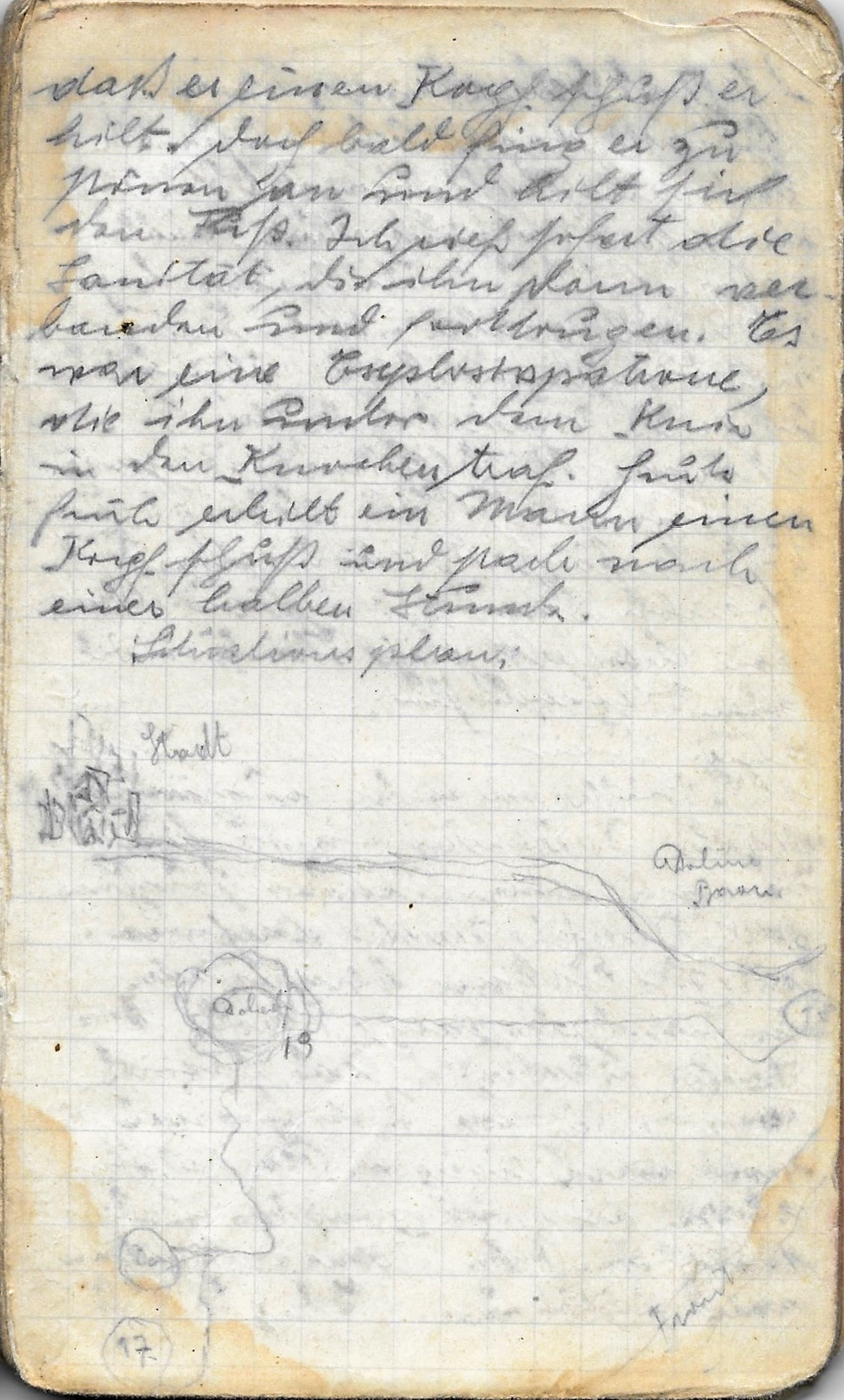
| that he was shot in the head. But he soon started screaming and holding his foot. I immediately called the paramedics, who bandaged him up and carried him away. It was a [??] cartridge that hit him below the knee in the bone. Early in the morning a man was shot in the head and died half an hour later. Situation plan (sketch) |
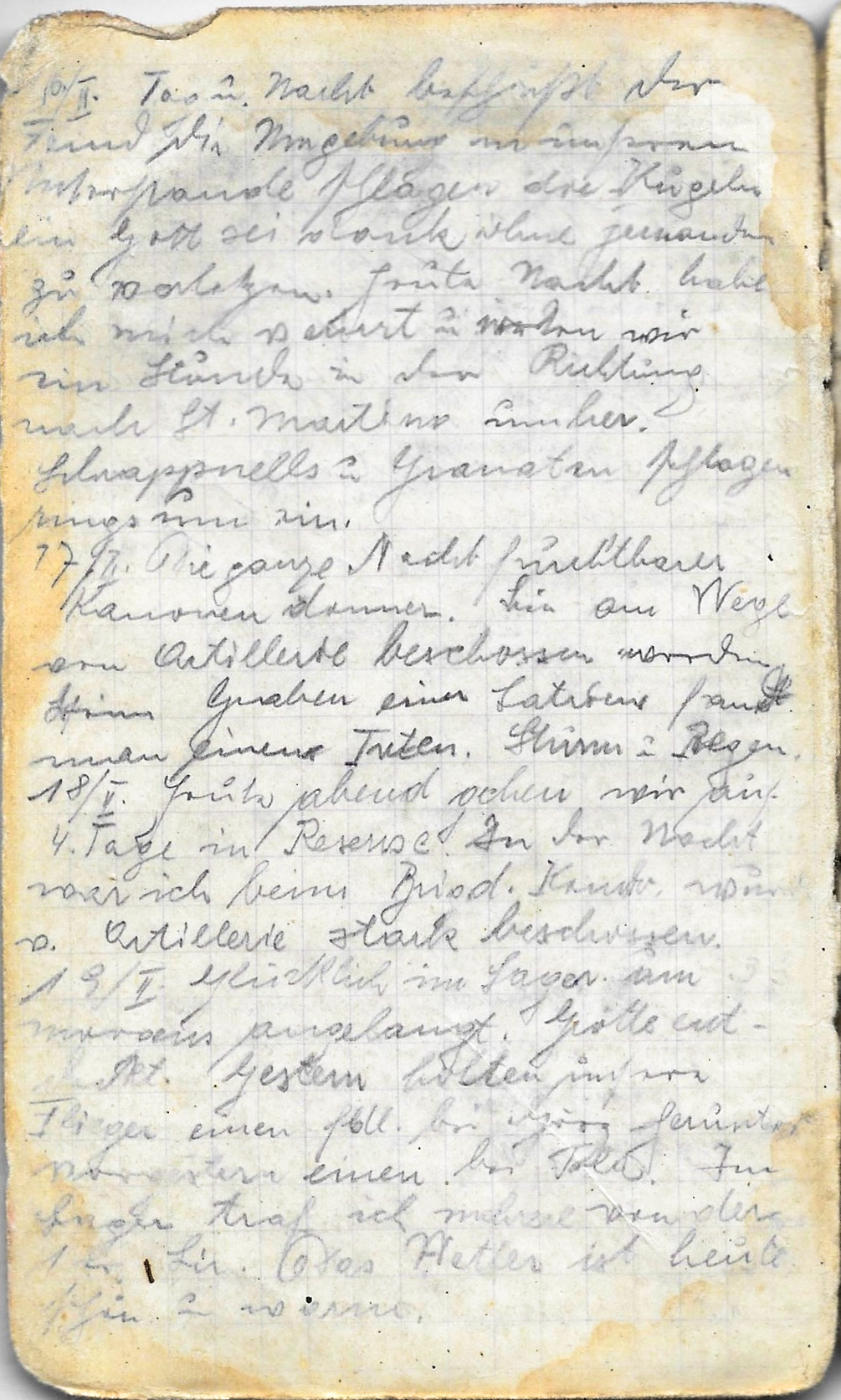
| 16./II. Day and night the enemy bombarded the area and bullets hit our dugout. Thank God without hurting anyone, early in the night I [??] and we wander around a bit in the direction of St. Martin. Shrapnel and shells hit all around us. 17./II. Terrible cannon thunder all night, I was shot at by artillery along the road. A dead man was found while digging a latrine. Storm and rain. 18./II. early in the evening we go into reserve for 4 days. During the night I was with the brigade command. We were heavily shelled by artillery. 19./II. We arrived happily in camp in the morning, I discovered a [toad?]. Yesterday our planes brought down an enemy at Gorizia, the day before yesterday another one at [T?]. In the camp I met several of the [1?]. LIR The weather is nice and warm today. |
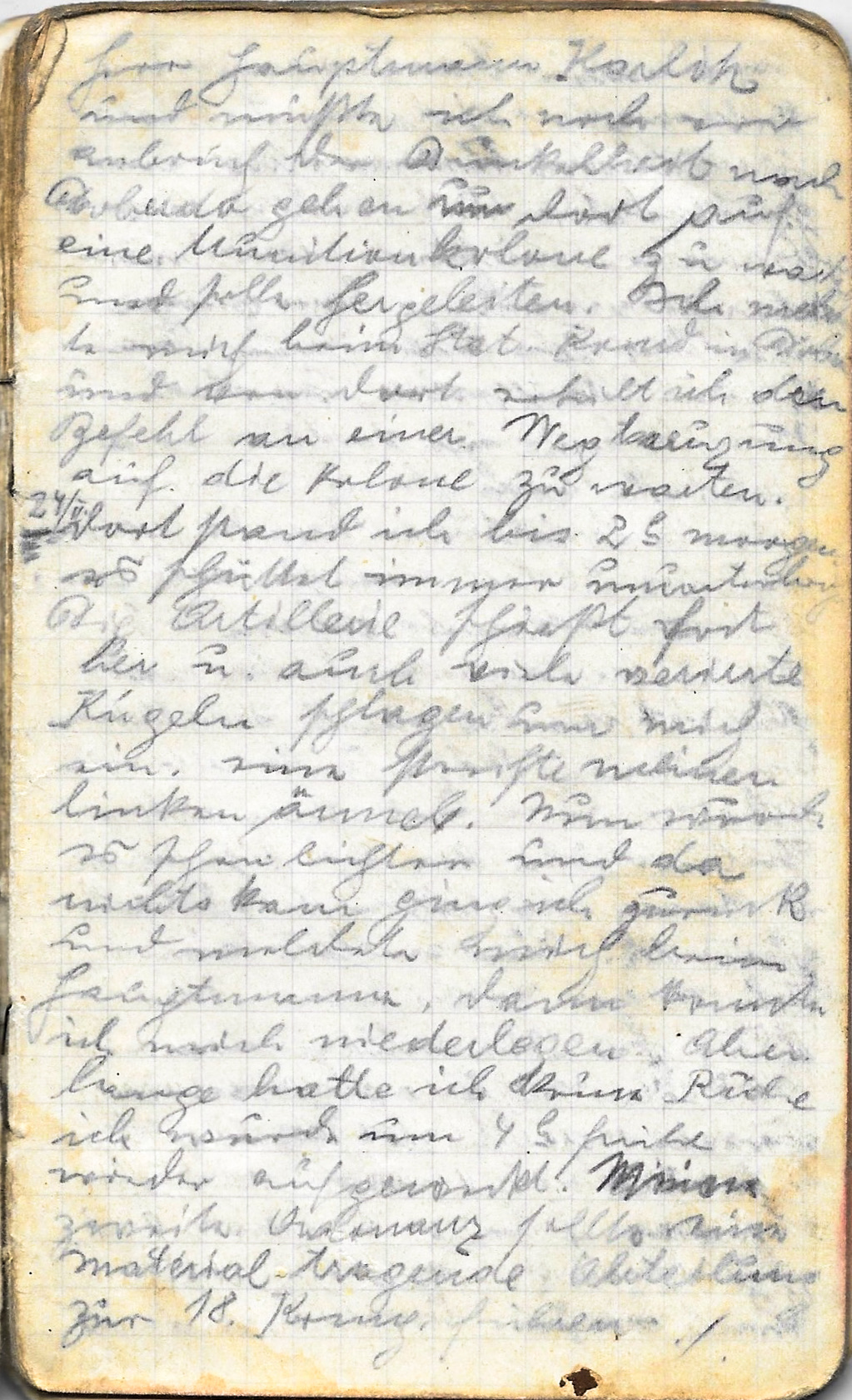
| For Captain Karlitz [and ?] I had to go to Doberdo before dark to wait for an ammunition column and guide them here. I reported to [??] and from there I received the order to wait for the column at a crossroads. 24./II. I stood there until 2 o’clock in the morning . It’s always pouring down. The artillery was almost firing here and many stray bullets were hitting nearby. One grazed my left sleeve. [??] now it grew dark quickly [??] and since nothing came I went back to and reported to the captain. Then I could lie down. But I had no rest for long. I was woken up again at 4am. My second ordinance was to lead a material-carrying unit to the 18. Companie… |
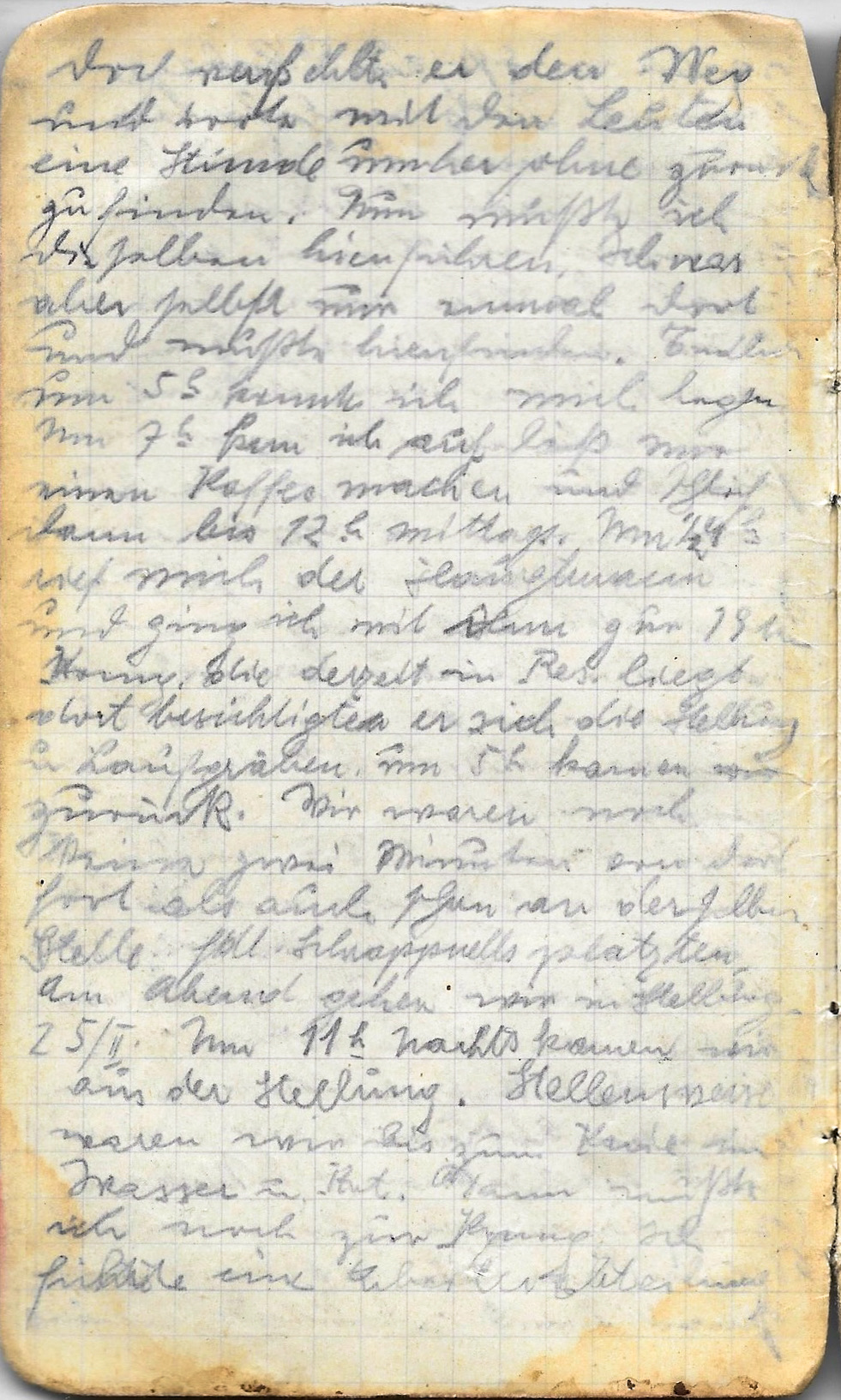
| but he missed his way and wandered around with the people for an hour without finding his way back. So I had to lead them home myself. But I had only been there twice myself and had to find my way. Finally at 5am I could lie down. At 7am I got up, had my coffee made and then slept until 12 noon. At ½ 3 the captain called me and I went with him to the 19th company, which is currently in reserve. There he inspected the position and the trenches. At 5 o’clock we came back. We had not been two minutes away from there when enemy shrapnel burst at the same place. We took up position in the evening. 25./II. We came out of the position at 11 o’clock at night. In some places we were up to our knees in water and excrement. Then I had to go to the company (HQ). I led a group of laborers |
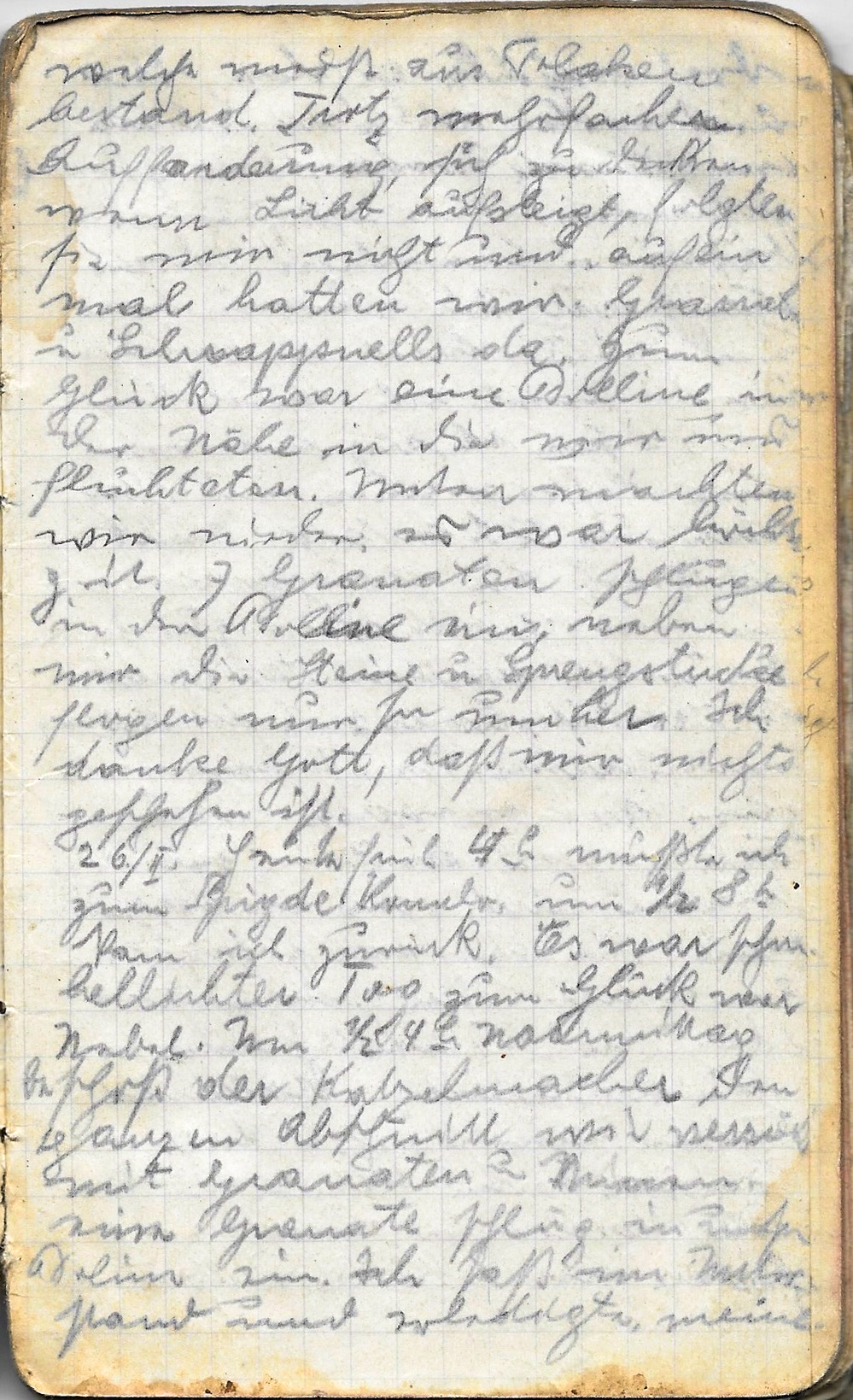
| which consisted mostly of Polaks. Despite several requests to cover themselves when the light flares were shot, they didn’t follow me and suddenly we had grenades and shrapnel on us. Luckily for there was a Doline nearby, into which we took refuge. Down below we made [??] good [??] time?? again. 7 grenades hit the Doline, next to me the stones and explosives were flying around. I thank God that nothing happened to me. 26.II. This morning at 4 o’clock I had to go to the brigade command, I returned at ½ 8. It was already broad daylight. Fortunately there was fog. At 3:30 in the afternoon the Katzelmacher attacked the whole front section with [??] with grenades and mines. [“Katzelmacher” is a derogatory word for Italians]. A grenade hit the dugout. I sat in the dugout and took my… |
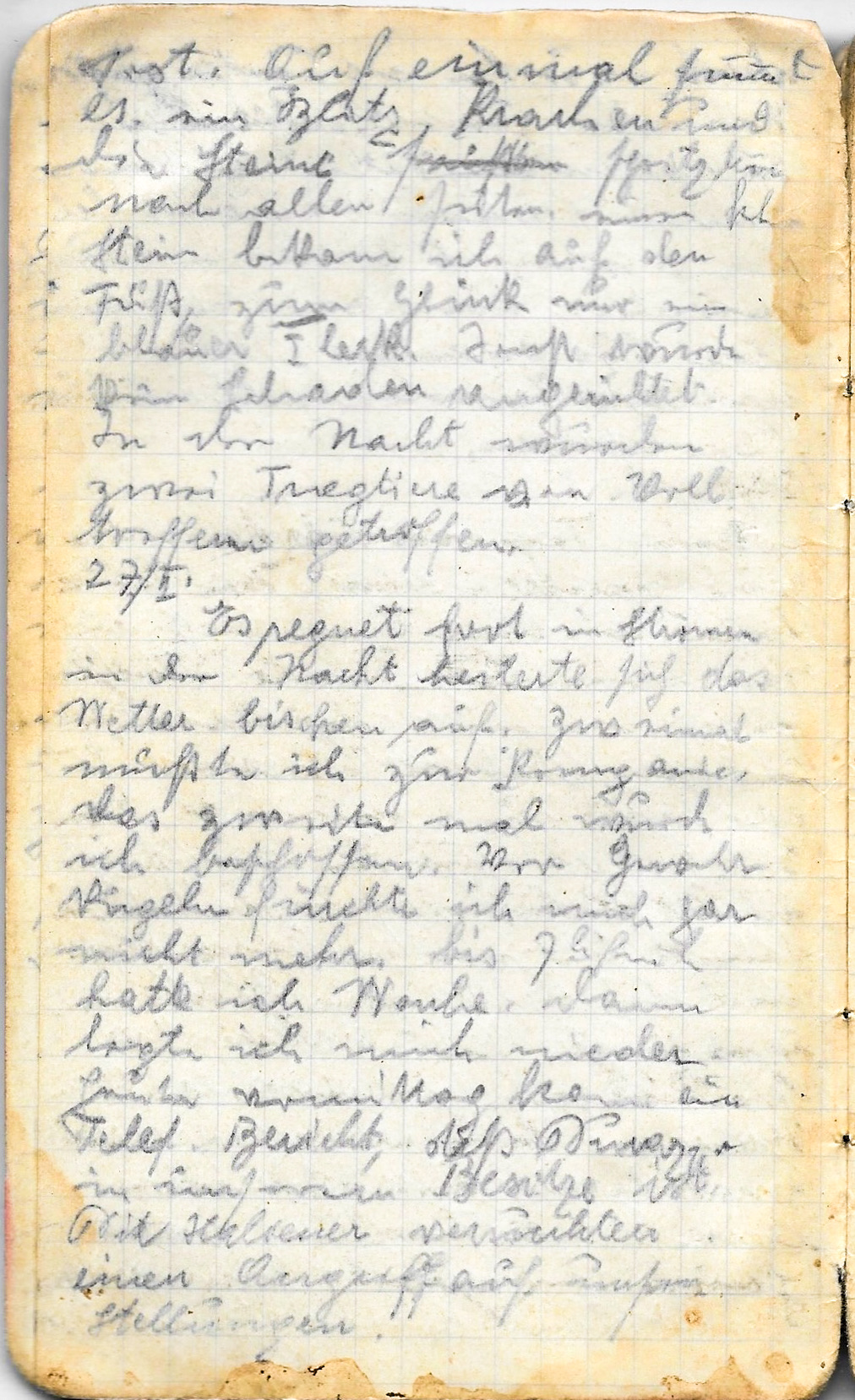
| but they were repulsed with great losses. They had over 120 men killed, while only 6 of our men were wounded. We also took over 170 prisoners. Our artillery ended everything with good results. 27/.II. During the day it was quiet, with occasional shells or mines. At 7:30 p.m. (evening) we had a artillery attack on the left flank. Suddenly, we saw green flares going upand then the shooting started. It lasted a full hour. At 11:30 at night we were relieved by Lst 152. The Katzelmacher only sent a few more grenades up, Thank God without hitting us. |
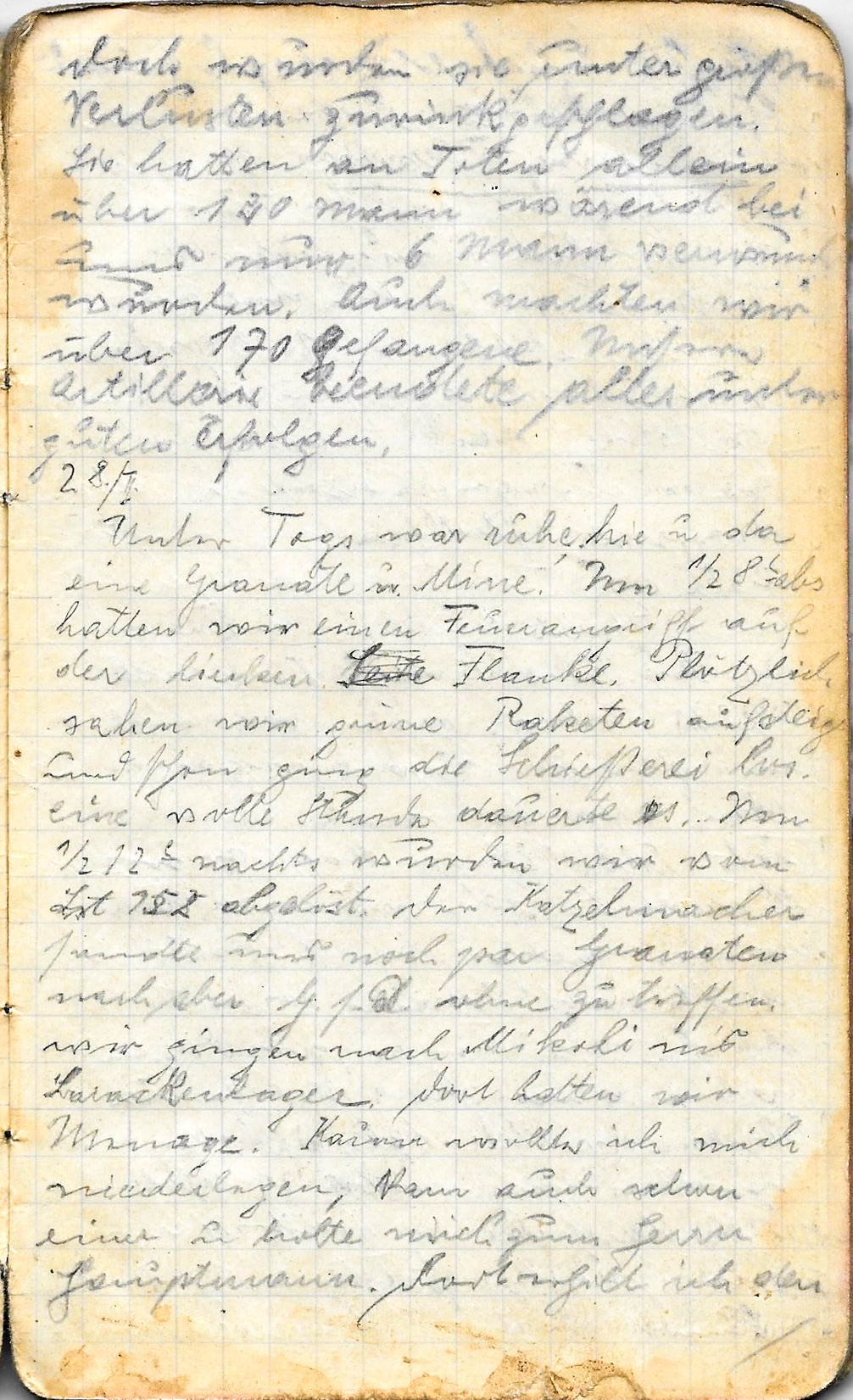
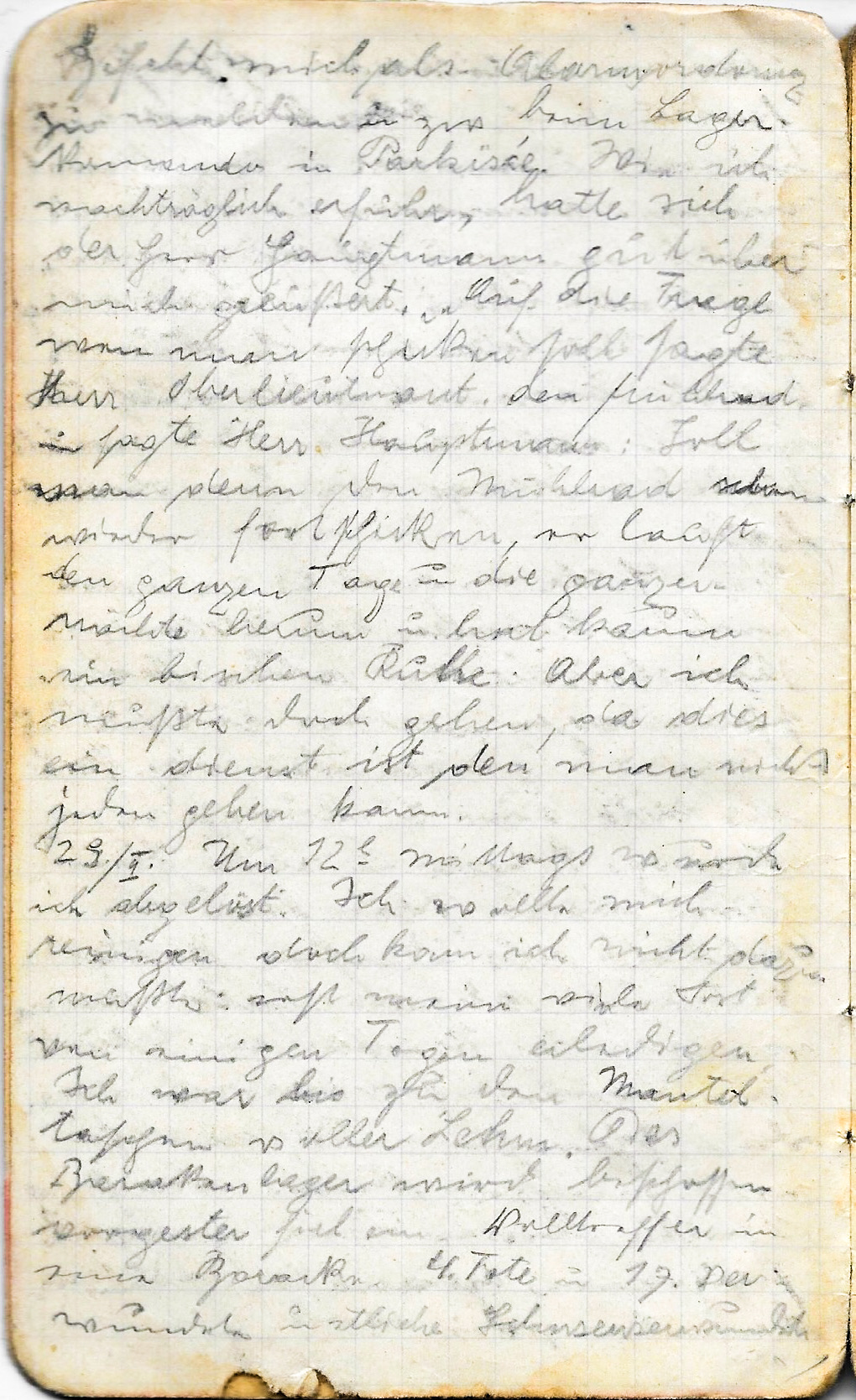
| order to report as ?alarm ordinance to the camp command in Palchise . As I learned later, the captain had spoken well of me. When asked who should be sent, the 2nd Leutenant said “the Mühlrad”, The captain said “Should we really send Mühlrad again? He runs around all day and all night and hardly gets any rest. “ But I had to go anyway, as this is a job that cannot be trusted to just anyone. 29/II [PJM Note: Feb. 29 confirms that this was 1916, a leap year.]. At 12 noon I was relieved. I wanted to clean myself but I didn’t get the chance. I first had to deal with all my mail from a few days ago. I was up to my coat ?? and full of mud. The barracks camp is being shelled. The day before yesterday a direct hit fell in a barrack. 4 dead and 17 wounded and several seriously wounded. |
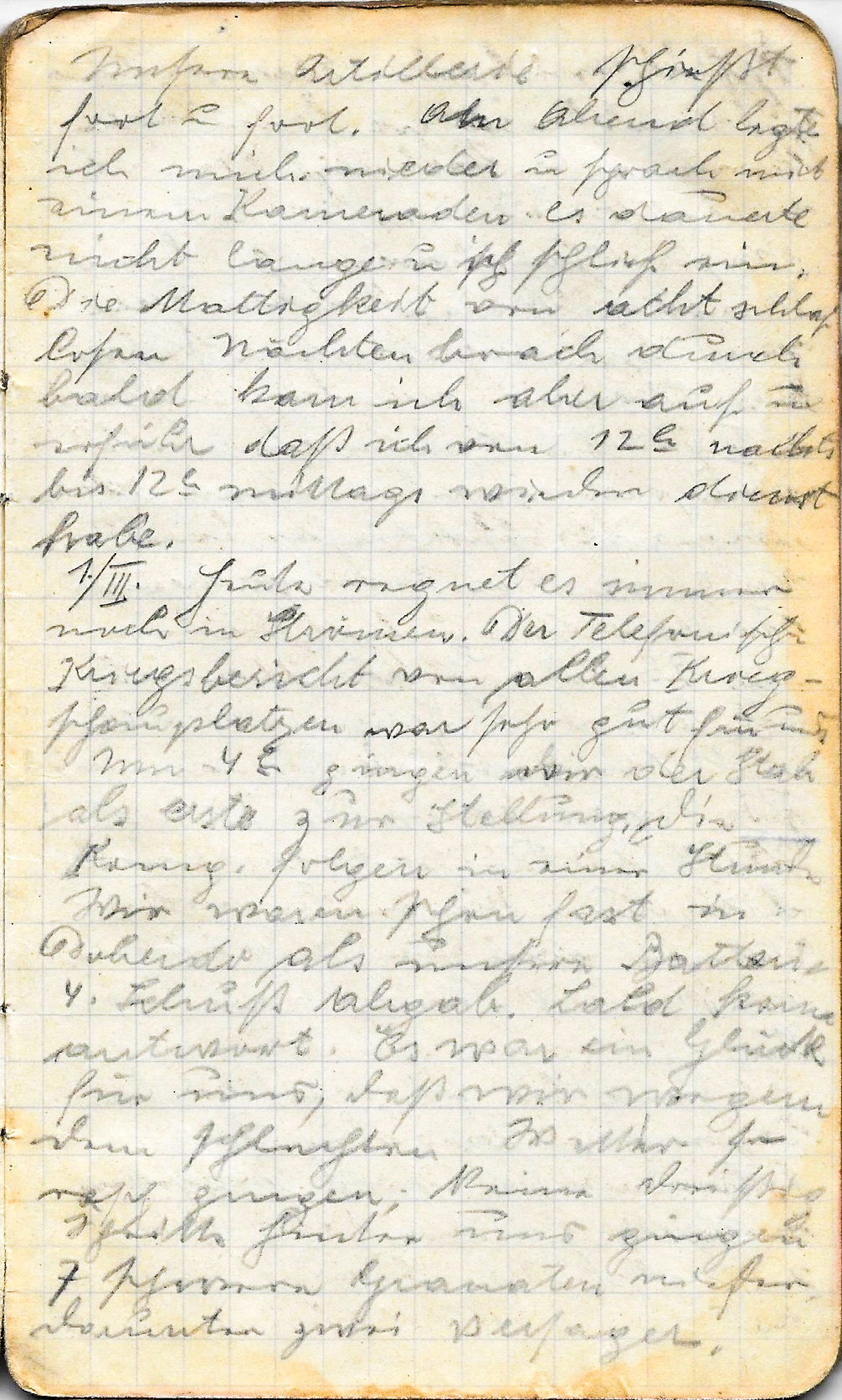
| Our artillery shoots on and on. In the evening I lay down and talked to my comrades. It didn’t take long and I fell asleep. The fatigue of eight sleepless nights soon broke through, but I got up and learned that I was on duty again from 12 o’clock at night until 12 noon. 1./III. Today it is still raining in torrents. The telephone war report from all the theaters of war was very good for us. At 4 o’clock we of the staff were the first to go to the position, the companies followed an hour later. We were almost at Doberdo when our battery fired 4 shots. Soon came the reply. It was lucky for us that early in the morning?? bad weather ? Less than thirty steps behind us 7 heavy shells fell, including two duds. |
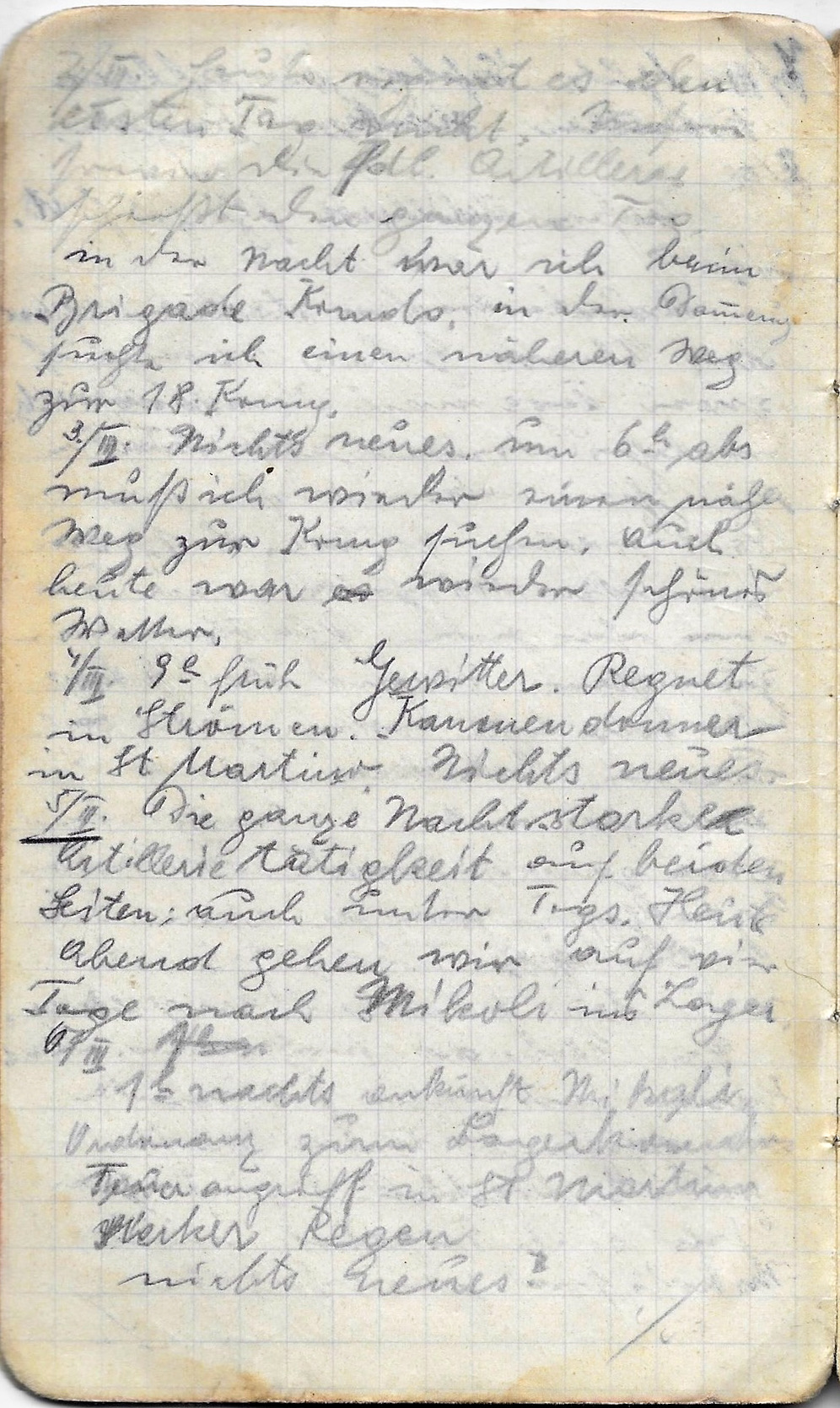
| 2nd/III. no rain for the first time today. Enemy artillery firing all day. At night I was with the brigade command. At dusk I scouted a closer route to the 18th Company. 3./III. Nothing new. At 6 o’clock in the evening I had to find another route to the company. Also today was nice weather again. 4./III. 9am thunderstorm. Raining in torrents. Cannon thunder in St. Martin. Nothing new. 5th/III. Heavy artillery activity all night on both sides. Also during the day. Today in the evening we are going to camp in Mikoli for four days. 6./III. arrival in Mikoli at night. I am orderly to the camp command. Fire attack in St. Martin heavy rain nothing new |
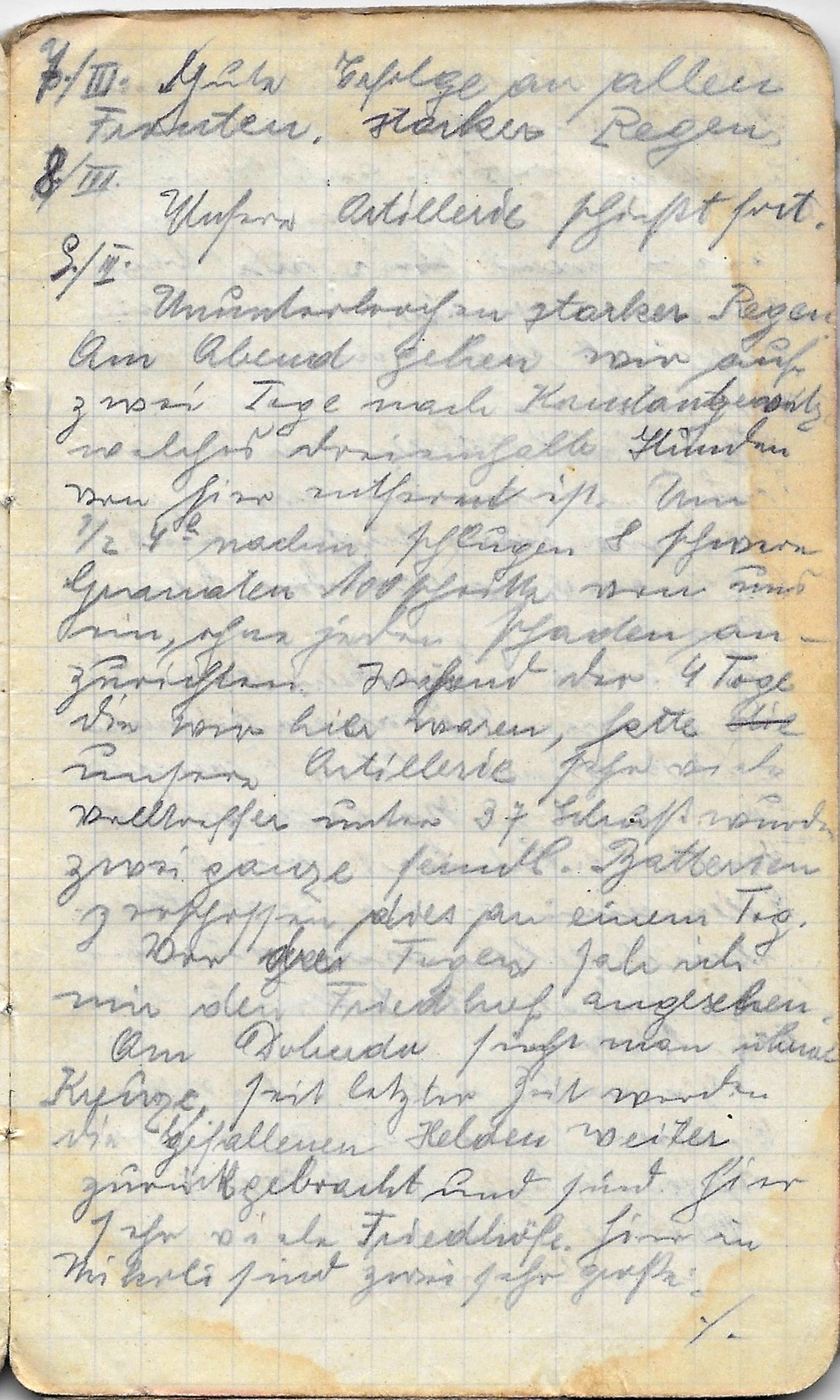
| 7/III. Good successes on all fronts. Heavy rain 8./III. Our artillery continues to fire. 9/III. Continuous heavy rain. In the evening we for two days to Kostanjevica, which is three and a half hours away from here. at ½ 4 in the afternoon 8 heavy shells hit 100 paces from us, without causing any damage. During the 4 days we were here, our artillery had a great many direct hits, two whole enemy batteries were shot to pieces with 37 rounds in one day. Three days ago I visited the cemetery. On the Doberdo you can see crosses everywhere, since recently the fallen heroes have been brought back further and there are a lot of cemeteries here. Here in Mikoli there are two very large… |
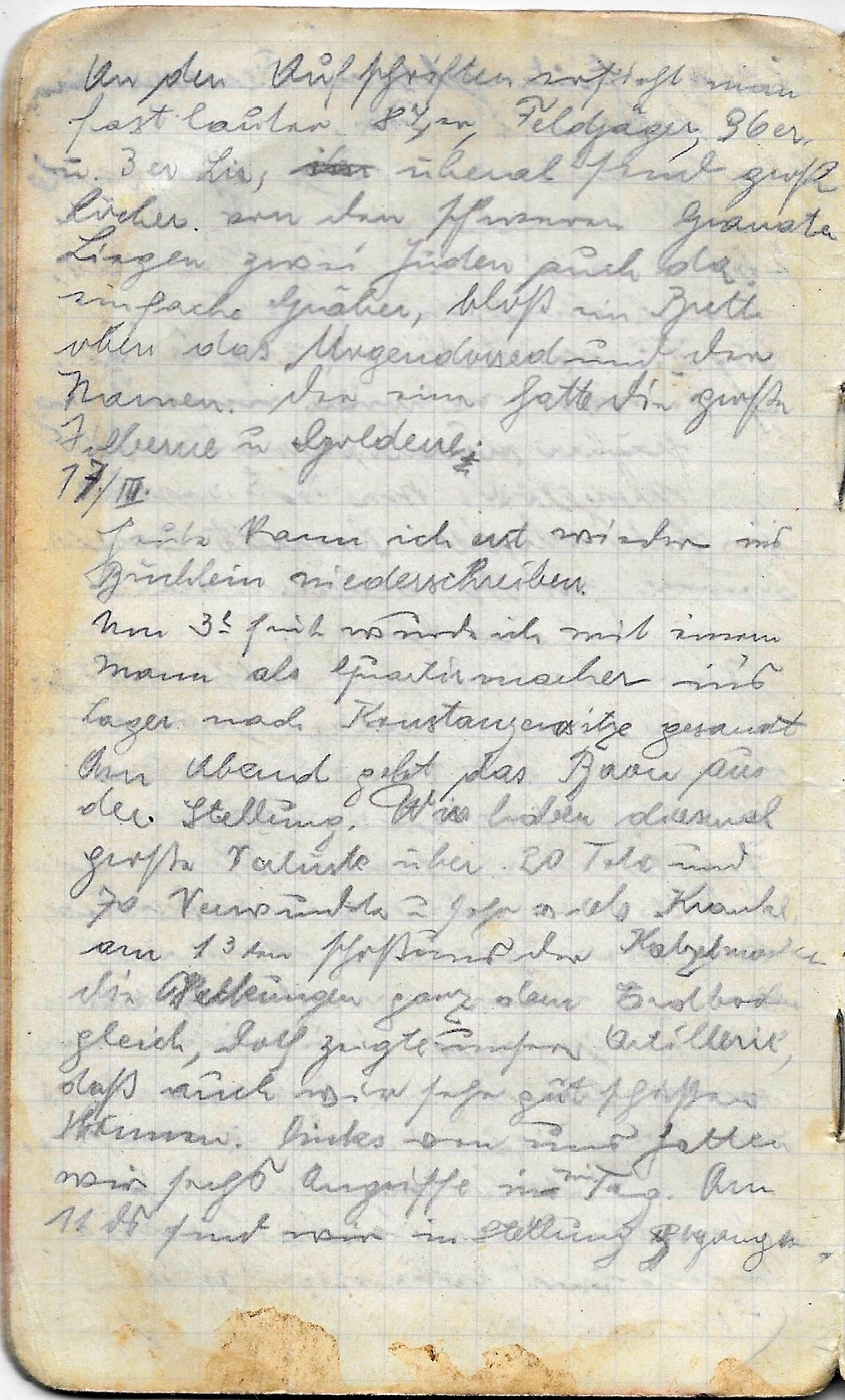
| ..from the inscriptions you can see, they are almost all 87s, Feldjäger, 36. and 37.LIR, there are big holes everywhere from the heavy shells. Two Jews are also there. Simple graves, just a board at the top with the Magendavid and the man’s name. One of them had the large silver and gold medal. 17./III. Today I can finally write in the booklet again. At 3 o’clock in the morning I was sent to the camp at Kostanjevica with a man as quartermaster. In the evening the Baon leaves the position. This time we have great losses, over 20 dead and 70 wounded and ?many? sick. On the 13th ??? ?? the Katzelmacher. razed the positions to the ground, but our artillery showed that we too can shoot well. On our left we had ?? attacks in two days. At 11.h we went into position. |
| [Blog post inprogress. More to come. |
Leave a Reply